



Our Planet: Once a Teenager, Now Approaching Dusk

“This is all wrong. I shouldn’t be up here. I should be back in school across the ocean. Yet you all come to us young people for hope? How dare you! You have stolen my dreams and my childhood with your empty words. But I am one of the lucky ones.” (Quote from Greta Thunberg's speech, a young activist representing the climate movement at the United Nations Climate Action Summit in 2019)
Climate Change has become a priority issue, a major problem that if we fail to address will lead to the collapse of biodiversity and the end of humanity and the planet as we know it. We have known the fact that from 2005-2015, sea levels rose an average of 3.6mm each year due to global warming. Air pollution, forest fires, marine plastic waste, are actually just the tip of the iceberg visible from the impacts of climate change on our lives. (Thalani, 2021)
Technological advancements on one hand, with various innovations occurring and evolving over time, have significantly contributed to the progress of world civilization, a fact that cannot be denied. However, on the other hand, it also denies the risks to the sustainability of the environment where we reside slowly. The adaptive knowledge systems that have been traditionally passed down through generations and maintained by all cultural civilizations have also been known and can be studied, that humans have an absolute dependence on the environment where they operate and survive.
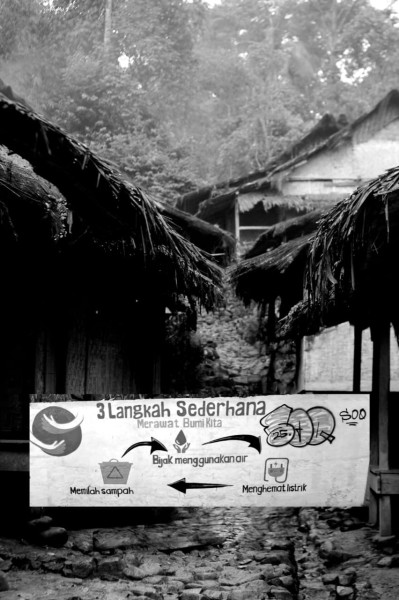
One of the remaining traditional societies that still preserves its environmental heritage and conservation is the Baduy Tribe. The philosophy of the Sundanese and Baduy tribes regarding the environment, which states leuweung ruksak, cai béak, manusa balangsak, has become the motto of the Sundanese Forest and Environmental Observers Council (DPKLTS), which is composed into the sentence “No Forest, No Water, No Future. Leuweung Ruksak, Cai Béak, Manusa Balangsak. No Forest, No Springs, No Future.” The Sundanese Forest and Environmental Observers Council itself is an organization focused on forest conservation, environmental protection, and empowering forest village communities in West Java and Banten through forestry, food, energy, institutional, local culture, law, disaster, and advocacy programs. This organization was established in 2001 and has conducted various activities.
The spread of research results has comprehensively explored the way of life, philosophy of life, and the efforts of the Baduy community in responding to modernization. Changes due to modernization, coupled with population growth, have pushed the Baduy community to make adjustments in core cultural aspects, especially in technology (techniques and knowledge) related to subsistence life and economic activities. The differences in how the two subcultures of Baduy adjust their core culture to these changes are largely due to their level of adherence to the pikukuh and buyut, which are the ethical-normative foundations inherited through the beliefs of Sunda Wiwitan religion. During this adaptation process, the core cultural elements of the Baduy community become crucial in determining how they respond to changes in their social and economic environment. Additionally, eco-spirituality, which is a system of spiritual values that serves as a guideline in managing natural resources, also plays an important role in how the Baduy community addresses the challenges of modernization and maintains their ecological balance. (Setiawan et al., 2023).
The consistency and steadfastness of the Baduy community in preserving their local wisdom can also be interpreted as a form of adaptation to the exposure of globalization and modernization. Such survival mechanisms and resistance are the Baduy community's response to changes and developments in global dynamics. They have priorities and values that need to be preserved, and this is very good for countering any negative impacts that may enter their territory and community. For instance, the Baduy Luar Tribe, with a more moderate level of adaptation, does not completely reject modernization, changes, reforms, or cultural transformations from outside (especially regarding education and economic activities). They remain vigilant, selective, and have strong reasons to accept certain transformations. Thus, on one hand, the Baduy Luar Tribe can minimize the negative influences caused by globalization. (Nurfalah et al., 2023)
The conclusion in the context of Earth Day 2025, which takes the theme “Our Strength, Our Planet,” is that there is no need to impose modern methods on communities that still firmly hold traditional knowledge systems in environmental conservation. Focus instead on modern communities that have neglected to preserve traditional heritage in caring for their living environment. Indeed, it is never too late to restore traditional understanding related to current environmental issues, but “Modern Problems Require Modern Solutions.” Collaborative efforts in addressing environmental issues and conservation between traditional communities and those with modern knowledge can both take real action without discrediting each other's methods and approaches. For the same noble goal, to care for the planet we all inhabit for a longer time. Certainly, so that other Gretas in the future do not suffer and blame us as the previous generation that bequeathed a dirty and uninhabitable planet to them.
“Heal the world… Make it a better place… For you and for me and the entire human race. There are people dying… If you care enough for the living… Make a better place for… You and for me.” (Michael Jackson – Heal The World 1991)
References
Thalani, Moh. Febri. 2021. Indonesian Youth and Climate Change. Friedrich-Naumann-Stiftung für die Freiheit. Jakarta.
Nurfalah, Lisa., Chesya Sera De Claresya, and Muhammad Brilliant Bidjaksono. 2023. Adaptation of the Baduy Luar Tribe to Global Developments Based on Local Wisdom. Journal of Socio-Cultural Sustainability and Resilience. VOLUME 1, ISSUE 1.
Setiawan, Nur., Rina Mardiana, and Soeryo Adiwibowo. 2023. Adaptation of the Baduy Community to Population Growth and Modernization: A Study of Cultural Ecology and Eco-spirituality in Kanekes Village, Lebak Regency, Banten. Focus Vol. 4, No. 2.
Bahrudin, Babul & Achmad Zurohman. The Cultural Dynamics of the Baduy Tribe in Facing Global Developments in Kanekes Village, Leuwidamar District, Lebak Regency, Banten Province. Zainul Hasan Islamic University. Probolinggo.
Senoaji, Gunggung. Social and Cultural Dynamics of the Baduy Community in Managing Forests and the Environment. Department of Forestry, Faculty of Agriculture, Bengkulu University.
-----------2004. Utilization of Forests and the Environment by the Baduy Community in Southern Banten.
Journal of Humanity and Environment, Vol. XI, No. 3, November 2004. Center for Environmental Studies, Gadjah Mada University. Yogyakarta.