



Pioneering the Rise of a Generation through Culture: From the Struggle for Identity to the Identity Crisis

Robert E. Elson in his book about the national awakening of Indonesia states that, "the idea of Indonesia that has been ongoing for a century or more shows no signs of waning in its invigorating strength." Furthermore, he says that the enthusiasm to continue living is supported by many Indonesians who truly realize that, "this nation-state is truly their land, and they themselves must continue to guard it" (Elson in Purwanto, 2008).
The birth of Ethical Politics has given rise to new individuals who have a fundamental understanding of who they are amidst the turmoil of foreign power that has been present in the Dutch East Indies for hundreds of years. The chasm that yawns wide is evident between the existence of foreigners who regulate the daily lives of the indigenous people. The meeting among the educated classes converges on a common question, namely national consciousness.
This line of thought marks the beginning of the struggle for ideas regarding the formation of Indonesia as part of the history of human civilization. The openness of information at that time, obtained from learning in schools with reading materials, unveiled the knowledge that they, the educated classes who were part of the Dutch East Indies, were merely a small fraction of the citizens of human civilization in the world. The shared fate of being under the grip of a foreign nation awakened the understanding that those who govern and manage their lives are not people from the same region where the educated classes reside. These rulers come from another part of the world. This creates an early dichotomy between us and them, and they do not come from where we are. A starting point in the struggle for national identity.
The daily behavior of the new generation with the opportunity to associate and gather lays the foundation for a shared determination to seek their common roots. The cultural backgrounds that have similarities are vastly different from the cultural backgrounds of the colonizers who regulate the life systems in the region that would later be fought for and born under the name Indonesia.
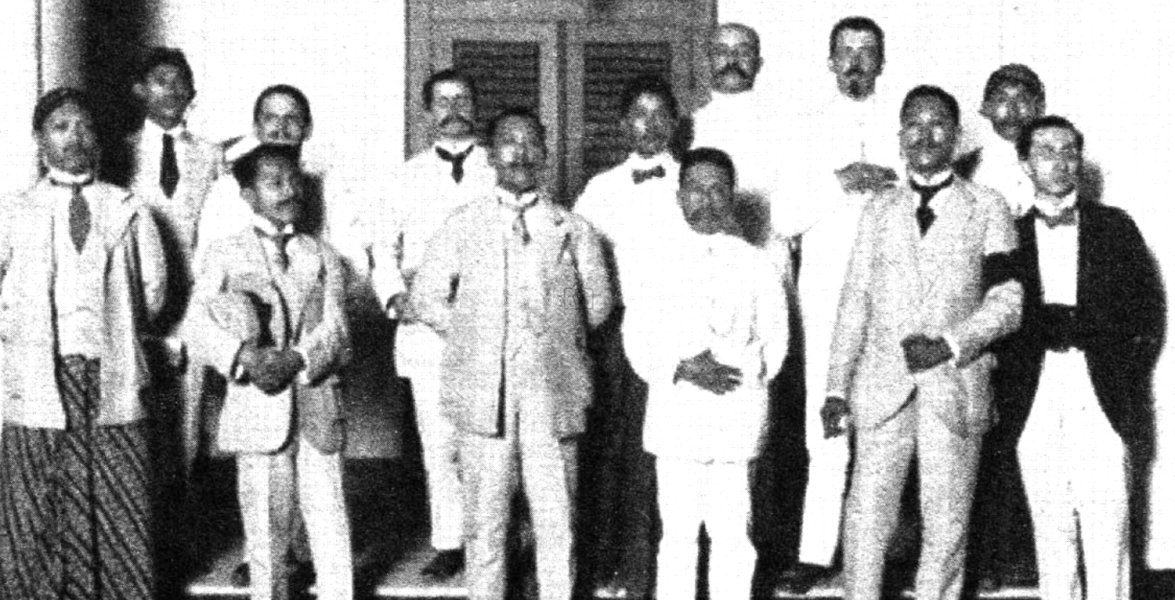
The struggle for identity through cultural means was pioneered through the Congres voor Javaansche Cultuur Ontwikkeling on July 5-7, 1918, in Surakarta. The congress, which is considered the first cultural thought milestone, discussed and debated cultural identity issues in line with the spirit of national awakening, although at that time the cultural discussions were limited to the perspective of Javanese culture. The impact of the Ethical Politics policy, this congress emphasized discussions about the awareness of "Eastern" civilization, strategies to catch up with Western civilization, the importance of broader education to reach the common people, and the formulation of a vision.
In relation to the growth of national consciousness and cultural awareness among ethnic communities, according to Nunus Supardi (2018), there are three interesting meanings to note. First, the awareness of national culture in the sense of the willingness and sincerity of ethnic groups to become part of the nation. The emergence of the awareness to become one bond of "one nation" reflects how deep the sincerity of each ethnic group is to change its status from an ethnic group to a nation. This elevation of status (to become a nation) brings about fundamental changes in the framework of thinking (paradigm) of society. The ethnic framework that has developed for centuries suddenly must change or rather be added to or elevated to a national framework. This elevation does not mean neglecting the ethnic way of thinking, but rather that way of thinking enriches and expands the national framework of thought.
Second, the awareness of national culture in the sense of a form of "cultural resistance." What is resisted is the culture of the colonizers in a broad sense. Although the culture of the colonizers is more developed in urban areas, it is supported by power, and its impact is felt by the wider community. In the life of a colonized nation, society does not have the freedom to actualize its ethnic identity, let alone its national identity freely. Culture, which is inherently dynamic and always develops in accordance with changes, is stifled by various repressive actions by the colonizing nation.
Third, the awareness of national culture in the sense of awareness of the fate of its culture—both national and ethnic culture—for the future. Recognition of the presence of national culture has consequences for the existence of ethnic culture and vice versa. The spirit of life as members of an ethnic group must not fade due to the shift in position to become members of a nation. This shift should instead become a driving force for the awareness to maintain the values of ethnic culture within the framework of nationalism. Therefore, for the sake of growth.
The three points made by Nunus Supardi are relevant not only when reading the history of cultural struggles in the past but also present issues and future challenges. The diversity of ethnic groups and their cultures should not be reinterpreted towards national disintegration. What has become the shared consensus of the nation's founders, originating from ethnic groups framed in the spirit of unity and Bhinneka Tunggal Ika, should not be thought of as needing to be unified again. The legitimacy of national unity is now structured to create cultural strategies to withstand the influx of various cultures from outside. If the challenge in the past was how to face Western colonial culture, now the onslaught of foreign cultures has also entered from other Eastern civilizations.
The search for identity that was once undertaken does not need to be laboriously repeated because everything is already evident. The fading understanding in daily life of its cultural roots has led to an identity crisis for the current generation. Of course, we do not want one by one the cultures carried by each ethnic group that forms the culture of the Indonesian nation to slowly fade and disappear on their own. Through the cultural strategy promoted by the Cultural Advancement Law, the national identity through its culture will remain preserved with development and utilization strategies. Culture, which is dynamic because it has undergone acculturation, assimilation, adoption, and adaptation, will continue to develop according to the desires of each generation in its era. It remains to convey to the public that all these evolving cultural products originate from clearly defined cultural roots.
References
Purwanto, Bambang. 2019. Historical Perspective on National Consciousness and Indonesia's Independence from a Cultural Dimension. Jurnal Historia: Journal of Educators and History Researchers Vol. II No. 2 (April 2019). Universitas Pendidikan Indonesia. Bandung.
Supardi, Nunus. 2018. Rainbow of Culture: 100 Years (1918-2018) of the Cultural Congress Towards the Advancement of National Culture, Record of Historical Footprints. Ministry of Education and Culture of the Republic of Indonesia