



Nurturing the Values of Goodness in Folktales Through Storytelling Innovation

Solo - Folktales are one of the oral traditions in society that are passed down through generations. These stories often contain the origins of a region. However, more importantly, folktales actually hold values of goodness, ideas, lessons, and most importantly, they preserve memories.
Almost every region in Indonesia has its own folktales. One of them is the story of the giant bones found in an area known as Sangiran. This area, which includes the regions of Karanganyar and Sragen, is buried with giant bones.
Sangiran is known as an archaeological site in Java, Indonesia. It is also recognized by scientists as one of the most important sites in the world for studying human fossils.
Cultural Ambassador of the Sangiran Site, Wahyu Widiyanta, recently shared with Solopos.com about the collective memory of the local community, especially the older generations, who believe that the large bones in the Sangiran area are remnants of giants that once lived in ancient times.
In fact, the story of the giant bones can be traced at the Manyarejo Archaeological Museum in Dukuh Manyarejo, Plupuh District, Sragen. The museum houses several documents that recount the legend of the giant bones.
The story begins in a hilly forest where there was a kingdom led by Raden Bandung. The forest was not very fertile, but the people could still live by engaging in agriculture and livestock. The people lived comfortably and peacefully.
However, this comfort and peace were disturbed by the arrival of a large number of giants. The giants were led by Tegopati. The people were terrified and exclaimed, “Ana buta, ana buta.” The term Buta or Buto in Javanese society is used to refer to evil giants that intend to harm.
Indeed, the giants wanted to seize the kingdom's land. Seeing this evil intent, Raden Bandung led and mobilized his troops to fight the giants. Unfortunately, Raden Bandung was defeated.
Despite his defeat, Raden Bandung managed to save himself, albeit wounded. He hid and meditated in the forest. Later, that forest became a settlement for the people, named Dukuh Tapan, Cangkol Village, Plupuh District.
After a long period of meditation, Raden Bandung received a revelation to dive into a pond surrounded by banyan trees. It is said that the pond was once located in Dusun Kedung Wringin, Bukuran Village, Kalijambe, Sragen.
In short, Raden Bandung then met Dewa Ruci at the pond. He was instructed to sharpen his long claws on a stone, which would then be used as a weapon to fight the giants.
This event is also related to the name of the village in Sangiran. In Javanese, sharpening with a stone is known as sangir. The name sangir was then used to refer to Dukuh Sangiran in Krikilan Village, Kalijambe.
As a result, Raden Bandung, who had newfound strength, was able to scatter the giant troops. Raden Bandung's sharp claws tore through the bodies of the giants. Tegopati himself eventually met his demise with his belly ripped open by Raden Bandung's claws. The bodies of the giants were buried in the earth of Sangiran.
That is the folktale that explains why giant bones are often found by local residents in the rice fields and their yards. Of course, this perspective changed with the arrival of world archaeologists to Sangiran.
However, through the folktale of Balung Buto, the collective memory of the community about the names of villages or dukuh in the area of the ancient human site of Sangiran is recorded. According to Wahyu, this folktale can serve as a marker of the potential existence of fossils in that place.
“So it’s like a thematic map that has been instilled by the community. Wherever that story exists, there are surely fossils. That was our ancestors' way of perhaps conserving, protecting, and preserving those bones. That’s why the story of Balung Buto was created,” he said.
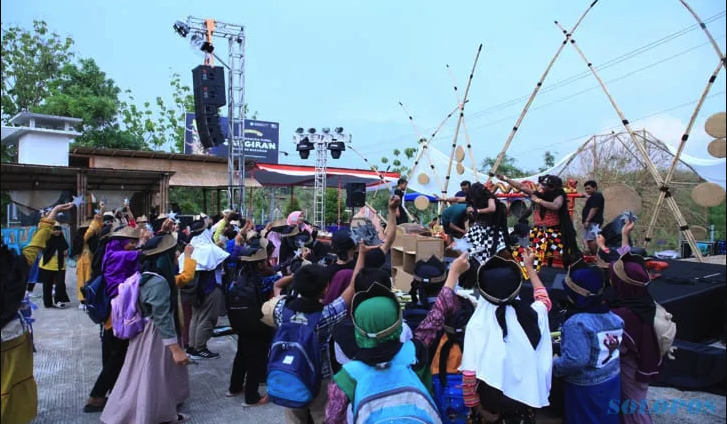
Interestingly, this folktale is still being preserved by the local community. Memories of the Balung Buto story continue to be nurtured by the local people in various ways. One of them is by packaging it through children's games and art performances.
“So we package the Balung Buto story into a traditional game, hoping that elementary school children will understand the local stories related to the Sangiran site,” said Wahyu.
In this traditional game, children are made to feel as if they are meeting the buto or giants. Then, in the game, the children, who are considered descendants of Raden Bandung, must strategize to defeat the resurrected buto.
From the Sangiran area, about 15 km – 16 km to the north, precisely in the Gunung Kemukus area, Pendem Village, Sumberlawang District, Sragen Regency, there is also a very popular folktale closely related to the origins of the religious area, Gunung Kemukus.
The story of Gunung Kemukus is inseparable from the tale of Pangeran Samodro, the son of Prabu Barwijaya V, the last king of Majapahit, who wanted to spread Islam during the twilight of the Hindu kingdom.
Pangeran Samodro migrated to Demak Bintoro as the influence of the Demak Sultanate's Islamic pattern strengthened at that time.
In Demak Bintoro, Pangeran Samodro deepened his knowledge of Islam under Sunan Kalijogo. After a few years, Sunan Kalijogo sent Pangeran Samodro to complete his religious knowledge by wandering to the Gunung Lawu area.
During his missionary journey, Pangeran Samodro fell ill and eventually died before he could return to Demak Bintoro. Pangeran Samodro was then buried on a hill located northwest of Dukuh Doyong. The grave is situated at an altitude of about 300 meters above sea level. Because the peak of the hill is often shrouded in white mist in the morning, resembling steam rising from a rice cooker, it was named Gunung Kemukus.
The story of Pangeran Samodro's journey has undergone shifts over the years. For many years, Gunung Kemukus transformed into a location for wealth rituals involving sexual rites, and it attracted global attention.
Currently, the local government is working hard to restore the image of Gunung Kemukus. It takes an extraordinary effort to erase the memory of Kemukus as a location for wealth rituals and sexual rites.
Even a caretaker of the grave, when receiving visits from the public, must be able to convince the pilgrims to come with a “piece” of the true story, not a distorted one.
“Indeed, many people ask why the story is different from what they heard outside or read in the media? This is what we really need to clarify, we need to guide the pilgrims to the grave,” said the grave caretaker.
From the stories of Balung Buto and Pangeran Samodro at Gunung Kemukus, the method of storytelling will greatly influence the strength or weakness of the local wisdom's defenses.
The caretaker of Pangeran Samodro's grave stated that currently, the most appropriate medium to convey the messages and values of goodness of Pangeran Samodro is to visit and see the grave of Pangeran Samodro at Gunung Kemukus directly.
He is very grateful to the schools that bring their students to visit and listen to the story of Pangeran Samodro directly from a credible source.
In this modern era, storytelling innovation or the creation of introducing folktales is very much needed.
In addition to being packaged through art and children's games, memories of folktales are also presented in other performing arts such as musical dramas. One platform that produces musical dramas based on folktales is Indonesiana.TV.
The platform owned by the Ministry of Education, Culture, Research, and Technology (Kemendikbudristek) features the folktale Calon Arang packaged in a drama performance lasting about 30 minutes. The actors, wearing traditional costumes from the local area, also sing.
Not only Calon Arang, but there are also other folktales packaged in a musical drama concept that airs on IndonesianaTV such as Si Pitung, Berta and the Cendrawasih Bird, and the story of Bawang Merah and Bawang Putih.
The traditional attributes and attractive visuals become an effective way to process people's memories about the various folktales that Indonesia possesses. Ultimately, folktales that are well recorded both orally and in writing need to be preserved to maintain the memory of the origins of the Indonesian people.
This article was published on Solopos.com on Friday, March 15, 2024.