



Understanding Indonesian Poetry Day

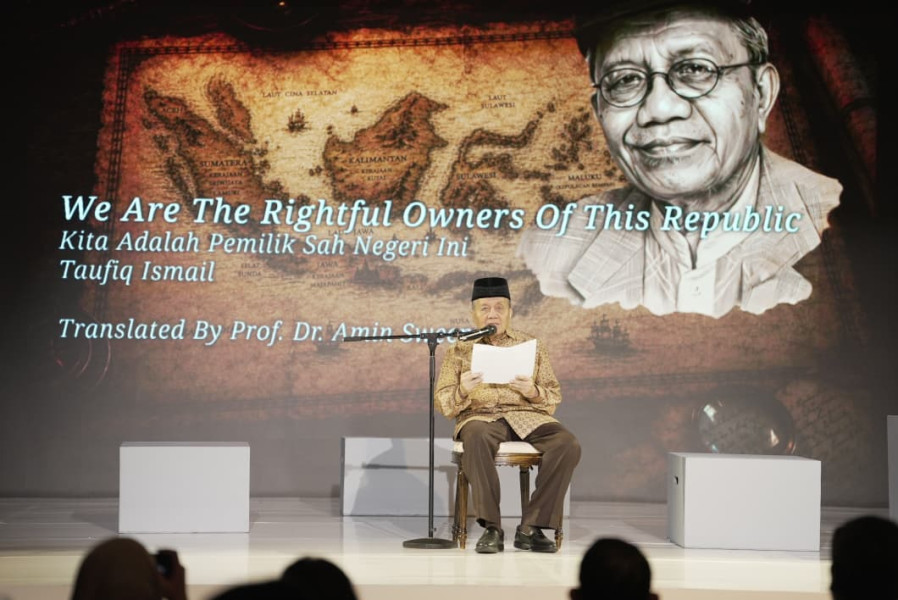
The rapid flow of information and culture makes poetry seem like a literary work that is increasingly silent. It is no longer the main reading material like news that changes every second or short videos that fill social media. However, it is precisely in that silence that poetry holds its power. Poetry invites us to pause for a moment, reflect, understand ourselves, and read life again through a language that is more honest and more humane.
That is why Indonesian Poetry Day, celebrated every July 26, coinciding with the birthday of Chairil Anwar, is not just a tribute to a great poet. This moment serves as a reminder that poetry has become an important part of Indonesia's cultural journey: recording the changes of the times, voicing the conscience of society, while also preserving the nation's identity through the power of words.
In fact, poetry in the archipelago existed long before Indonesia was established as a country. Various regions have forms of oral literature that have been passed down through generations, such as pantun in Malay society, gurindam in the Riau Islands, syair, mantras, Javanese tembang, Sundanese pupuh, and various traditional songs in other regions. All of this shows that poetry is not just a literary work, but a way for society to store knowledge, convey advice, nurture values of life, and strengthen intergenerational relationships.
During the colonial era, Indonesian literature entered a new chapter. The Dutch East Indies government, through Balai Pustaka established in 1917, opened opportunities for the birth of modern literary works in Malay, but at the same time also imposed strict supervision over the content of public readings. Literature developed within a limited space, while the opportunity to obtain education and literacy was still enjoyed by a small portion of society.
Poetry at that time was heavily influenced by old forms with relatively limited themes. Nevertheless, the works of Muhammad Yamin, Rustam Effendi, and Sanusi Pane became an important foundation for the emergence of modern Indonesian literature. They demonstrated that the Indonesian language could be a strong medium of expression as well as a unifying force for the growing national consciousness.
The spirit of renewal became more pronounced with the emergence of the Pujangga Baru generation in the 1930s. Poets began to present poetry that was freer, more personal, and more open to humanitarian issues. Poetry was no longer just about praising the beauty of nature or expressing gratitude, but also spoke about love, inner struggles, nationalism, and the aspirations for the nation's future. From here, Indonesian literature began to find its modern character.
The greatest change came through the 45 Generation, when poetry became part of the pulse of the nation's struggle. The revolutionary period gave birth to works full of anxiety, courage, and the spirit of independence. The form of poetry was no longer limited by rules of rhyme or the number of stanzas. The language became more straightforward, metaphorical, and expressive. In such an atmosphere, Chairil Anwar emerged as a figure who changed the face of Indonesian poetry.
Chairil Anwar not only renewed the form of poetry but also the way poets viewed the world. Through his works, he showed that poetry could be a space for freedom of thought, the courage to question the status quo, and a statement about human dignity. Poems like "Aku" and "Karawang—Bekasi" continue to live beyond their time because they speak of universal values: courage, freedom, loss, and hope.
The journey of Indonesian poetry certainly did not stop with Chairil Anwar. From W.S. Rendra, who loudly criticized social injustice, Sapardi Djoko Damono, who presented simplicity with depth of meaning, Sutardji Calzoum Bachri, who experimented with the sounds of language, to Joko Pinurbo, who highlighted everyday life with touches of humor and reflection, each generation adds a new color to the development of Indonesian literature. This diversity keeps Indonesian poetry alive and evolving.
Now, in the digital era, poetry finds a broader space for expression. Literary festivals, poetry readings, creative writing classes, literacy communities, and social media connect poets and readers without being limited by geographical space. Many young generations write and recite poetry through short videos, podcasts, musical performances of poetry, or digital posters. This phenomenon shows that poetry has never truly lost its readers; it has simply found different mediums.
However, this development also presents new challenges. The speed of information flow often makes literary works consumed only at a glance. Many poems are cut into short quotes in pursuit of popularity, while the complete meaning that the poet wishes to convey is overlooked. Therefore, building a culture of literary appreciation becomes an important task, not only for poets and academics but also for schools, families, communities, media, and cultural preservation institutions.
In the end, Indonesian Poetry Day is not just a celebration for poets. This moment reminds us that a great nation is not only built by economic progress, science, and technology, but also by the ability to nurture its language, imagination, and culture. Poetry teaches sensitivity to see issues from a more humane perspective, trains empathy towards others, and immortalizes life experiences so they do not fade away with time.