



The Meaning of Islamic New Year 1 Suro Year Hijri

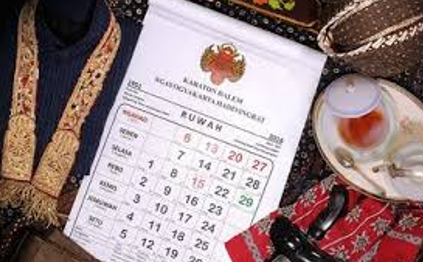
The Islamic New Year, marked by the commemoration of 1 Muharram, holds profound significance for Muslims around the world. In this historic moment, Muslims reflect on the meaning of the migration journey of Prophet Muhammad SAW from Mecca to Medina and draw lessons from his struggles.
Do you know the history of the 1 Muharram calendar and how it differs from the globally used Gregorian calendar? Here, we will explore and understand the meaning of the Islamic New Year, as well as compare its differences with the Gregorian calendar.
1 Muharram also marks the beginning of the new year in the Hijri calendar. The Islamic New Year is often celebrated with prayers, reflections, and hopes for a good start to the new year.
In the year 2025, 1 Muharram 1447 Hijri falls on Friday, June 27, 2025, based on the Joint Decree (SKB) of 3 Ministers regarding National Holidays and Joint Leave for 2025.[1] The night of the Islamic New Year will be counted from the evening of June 26, 2025.[2] The Islamic New Year is a celebration that holds more meaning than just a mere festivity.
Understanding the Islamic New Year
This Hijri New Year is also used to determine important dates in Islam, such as the month of Ramadan, Eid al-Fitr, and Eid al-Adha. The Hijri New Year has a meaning rooted in the event of the migration of Prophet Muhammad SAW. During the time of the Prophet, the migration was carried out as a da'wah strategy and as a response to the unfavorable situation in Mecca. Migration signifies the struggle to leave negative things and move towards a better direction.
The wisdom of the New Year includes:
1. A symbol of a new beginning
The Islamic New Year on 1 Muharram marks a new beginning in the Hijri calendar. It symbolizes an opportunity for Muslims to start anew and improve themselves.
2. Taking lessons from the migration event
This commemoration reminds Muslims of the commitment and struggles of Prophet Muhammad SAW and his companions in upholding the religion and building a society based on Islam.
3. An opportunity for self-reflection
The Islamic New Year 1 Muharram provides Muslims with a chance to reflect on their life journey over the past year.
4. Realizing the passage of irreplaceable time
During the Islamic New Year celebration, Muslims are encouraged to seize every opportunity to perform good deeds that can benefit themselves and others.
Becoming a Nusantara Culture
Before the arrival of Islam, the Javanese people already had an established calendar system, namely the Saka or Hindu calendar. The Saka calendar is calculated based on the Earth's orbit around the Sun, so the number of days is the same as the Gregorian calendar, which is 365/366 days. However, the Saka calendar is primarily used to mark the momentum of religious rituals for the Hindu community.
A Hijri year consists of 354 days, 8 hours, 48 minutes, and 35 seconds or 354.3670694 days. Islam brought the Hijri calendar, which is based on the lunar revolution around the Earth (Qamariyah). Simplifying, it is known that the number of days in a Hijri year is 354 11/30 days. Because it is not a whole number, the Hijri calendar also has long years (leap years) and short years (basithah years). Thus, in every 30 years, there are 11 long years and 19 short years. A long year has 355 days, and a short year has 354 days. Simplifying, it is known that the number of days in a year is 354 11/30 days.
From the Saka calendar, the year count is taken as the Javanese year. Thus, the Javanese year does not start from 1 Jawa but continues from the year 155 Jawa. The history of the Hijri year becoming the official calendar in the archipelago began with the impact of the spread of Islam in the archipelago. One of the cultural influences of Islam in the archipelago is the conversion of the calendar commonly used by the Indonesian people, namely the Hindu (Saka) calendar, to the Islamic (Hijri) calendar.
As happened in the Majapahit kingdom, where every month of Caitra (March) of the Saka year is commemorated with a religious ceremony. In the cultural context of Indonesia, the establishment of the Islamic New Year occurred during the Islamic Mataram Kingdom, through the decree of Sultan Agung Hanyokrokusumo, in the year 1633 AD, coinciding with the year 155 Saka or 1043 Hijri.[3]
He worked hard to spread Islam throughout the island of Java, almost all of Java except Batavia (VOC) and the Sultanate of Banten. At that time, the Hijri date calculation was used by the Javanese (Muslim) Mataram community that controlled Java. His power covered all of Central Java and most of West Java (Priangan) and parts of East Java controlled by Mataram.[4]
Conversion from Saka Year to Hijri Year
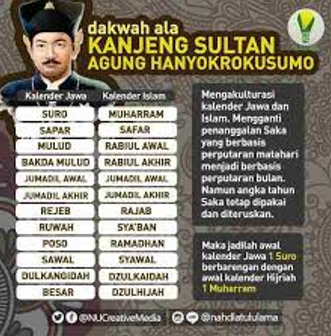
The names of the months in the Javanese calendar actually adopt the names of the Islamic months that have been Javanized. Thus, it can be concluded that the date 1 Suro is the same as 1 Muharram, more than 30 days. However, this reality is not always certain. For example, the month of Ramadan sometimes consists of 29 days, but in other years it can reach 30 days.
Therefore, a more accurate and certain way to determine the number of days in a month is through the observation of the hilal (rukyah). This observation must be done very carefully and with the holy oath of the observer and witnesses. In Indonesia, we know the Hilal Calculation Agency, together with the Ministry of Religion, which is tasked with observing the hilal in a specific place. Scientists, in this case, experts in astronomy and celestial science, observe the size of the hilal to determine whether it is 29 or complete it to 30 days in a month.
Meanwhile, Hisab or calculation becomes a method often used to establish the Hijri calendar in a year. Sheikh Syaraf al-Qudah even stated the principle that the determination of the lunar month should be based on hisab.[1]
The names of the months in the Islamic Javanese calendar are:
1. Muharram = Suro (Assyura)
Why is Muharram replaced with Suro? Because in Muharram, there is the event of 10 Suro. The month of Assyura is commonly known by the Arab Jahiliyyah community as the month of Awal. The Javanese people refer to it as Suro, known to the Jahiliyyah community on the 10th of Assyura. There are 20 important events on the Day of Ashura on 10 Muharram, namely:
a). The acceptance of the repentance of Prophet Adam AS after being sent down from heaven.
b). The release of Prophet Noah AS from the ship after the great flood. Prophet Noah's ship docked safely on the hill of Zuhdi on the day of Ashura.
c). The salvation of Prophet Abraham AS from the fire of King Nimrod. Prophet Abraham AS was saved from the torture of King Nimrod.
d). The release of Prophet Joseph AS from prison.
This handsome prophet was slandered until he finally entered the barred chamber.
e). The release of Prophet Jonah AS from the belly of the fish Nun.
Prophet Jonah was swallowed by the fish Nun when he jumped into the sea when he felt the ship he was on was not moving.
f). The healing of Prophet Job AS from a prolonged skin disease.
Prophet Job AS once faced a test from Allah SWT by suffering from a skin disease that caused a foul smell.
g). The parting of the sea for the Children of Israel fleeing from the pursuit of the cruel King Pharaoh of Egypt.
h). The creation of Prophet Adam AS in heaven.
i). The acceptance of the repentance of Prophet Jonah AS.
j). The birth of Prophet Abraham AS.
k). The release of Prophet Joseph AS from the well after being thrown in by his brothers.
l). The reunion of Prophet Joseph AS with his family.
m). The drowning of Pharaoh at the bottom of the Red Sea while pursuing Prophet Moses AS.
n). The ascension of Prophet Idris AS to a high place.
o). The revelation of the Torah to Prophet Moses AS.
p). The healing of the blindness of Prophet Jacob AS through the use of the clothing of Prophet Joseph AS.
q). The forgiveness of Prophet David AS for his mistakes.
r). The granting of power to Prophet Solomon AS in the form of a kingdom.
s). The ascension of Prophet Jesus AS to heaven after being besieged by the Romans.
t). The forgiveness of past and future mistakes of Prophet Muhammad SAW.
2. Sapar (Safar)
3. Rabiul Awal (Mulud)
Rabiul Awal is the third month in the Hijri calendar, the Islamic calendar based on the lunar cycle. This month holds significant meaning in Islamic history and tradition, especially because it marks the birth of Prophet Muhammad SAW, the last messenger of Allah.
In addition to the commemoration of his birth, Rabiul Awal is also known for several other important events, such as the passing of Prophet Muhammad SAW on the same date, 12 Rabiul Awal, but in a different year, namely 632 AD. The passing of the Prophet marks the end of the prophetic era, but his teachings and life examples remain a guide for Muslims to this day.
The commemoration of the Prophet's Mawlid is often used as a moment to strengthen ties and enhance brotherhood among Muslims, increase worship, recite blessings, and deepen understanding of the Prophet's teachings.
4. Rabiul Tsani/Rabiul Akhir (Bakda mulud)
Rabiul Akhir or Rabi‘uts Tsani is the 4th month in the Hijri calendar or lunar-based calendar. The naming is not separate from natural events, the rabi season or spring that occurs in the Arabian Peninsula. During this season, the grass turns green, plants grow abundantly, and many trees bear fruit. Rabiul Tsani, also known as Rabiul Akhir, in Javanese culture. The term "Ba'da Mulud" means "after the Mawlid of Prophet Muhammad SAW."
5. Jumadil awal (Jumadilawal)
6. Jumadil akhir (Jumadilakir)
7. Rajab (Rejeb)
The month of Rajab is the seventh month in the Hijri calendar and is one of the four sacred months (noble months) in Islam. This month is honored for its special characteristics and is an appropriate time to increase worship and draw closer to Allah SWT.
In the month of Rajab, the event of Isra and Mi'raj occurs, the journey of the Prophet Muhammad SAW from Masjidil Haram to Masjidil Aqsa and to Sidhratul Muntaha (the Seventh Heaven), marking the ultimate limit that cannot be surpassed by Allah's creations. Muslims are encouraged to increase good deeds such as voluntary fasting, voluntary prayers, dhikr, and reading the Quran.
8. Sya’ban (Ruwah)
Why is Sya’ban called Ruwah? Ruwah comes from the Arabic word arwah. Gus Baha or KH Ahmad Bahauddin Nursalim explains that the origin of ruwah comes from the Arabic vocabulary, namely “arwah” and is subsequently absorbed into the Javanese language as “Ruwah”.[6]
9. Ramadhan (Poso)
The month of Ramadan is a month that holds its own meaning and significance for Muslims around the world. Every year, Muslims observe fasting to control their desires during the month of Ramadan as one of the five pillars of Islam. It contains the night of Lailatul Qadr, which is considered a night full of blessings and virtues. During the month of Ramadan, Muslims are encouraged to increase worship, read the Quran, pray, and perform good deeds more intensively.
10. Syawal (Sawal)
11. Dzulqaidah (Selo)
Dzulqaidah is known as the month Selo in Javanese culture. According to the Javanese people, Selo means Apit or pinched. This is because this month lies between two major holidays, namely Eid al-Fitr (Syawal) and Eid al-Adha (Dzulhijah). It is also called Selo because this month is a break from those two major holidays.
12. Zulhijjah (Besar)
Secondly, Islam was perfected in the month of Dzulhijjah: Furthermore, the month of Dzulhijjah is the month in which Islam was perfected. This virtue is as the Eid al-Adha holiday occurs in this month. This month is also referred to as the Great Month.
[1] Sultan Agung of Mataram, who ruled from 1613-1645.
[2] Then on the date coinciding with July 8, 1633 AD. The decision was established by Sultan Abdul Mufakhir Mahmud Abdul Kadir, the fourth Sultan of Banten, who ruled from 1596-1651 from Banten. Based on this, the date 1 Muharram 1043 Hijri at that time was written as 1 Muharram 1555 Javanese. Tubagus Nurfadhil Azmatkhan. 2016. "History of the Banten Sultanate from Era to Era" Official Website of the Banten Sultanate. Accessed on 2025-04-14.
[3] Joint Decree of the Minister of Religion, Minister of Manpower, and Minister of State Apparatus Utilization and Bureaucratic Reform of the Republic of Indonesia Number 1017, year 2024. Regarding National Holidays and Joint Leave for 2025.
[ 4] Because the Gregorian calendar determines the start of the day at 00:00 midnight based on local time. Meanwhile, the Hijri calendar determines the start of the day based on the rising of the sun until sunset (around 18:00). The moment of sunset marks the end of the day and the beginning of a new day in the Hijri calendar.
[5] Masruhan. Journal of Islamic Legal Thought Vol 13 No 1 Year 2017. “Islamic Effect on Calendar of Javanese Community,” .
[6]K.H Mamoen Zubair. Ngaji Bersama. 2017. ”Kalam-Kajian Dalam Islam”, You Tube, Monday 14-03-2017
REFERENCE LIST
Masruhan. Journal of Islamic Legal Thought Vol 13 No 1 Year 2017. “Islamic Effect on Calendar of Javanese Community,” .
Joint Decree of the Minister of Religion, Minister of Manpower, and Minister of State Apparatus Utilization and Bureaucratic Reform of the Republic of Indonesia Number 1017, year 2024. Regarding National Holidays and Joint Leave for 2025.
K.H Mamoen Zubair. Ngaji Bersama. 2017. ”Kalam-Kajian Dalam Islam”, You Tube, Tuesday, 14-03-2017
Nurfadhil Azmatkhan, Tubagus. 2016. "History of the Banten Sultanate from Era to Era" Official Website of the Banten Sultanate.