



The Song “Lenggang Jakarta” (1950), Gliding to the Capital City (MUDIK)

Mudik has arrived, mudik has arrived. Reviews or discussions about the mudik phenomenon have been widely circulated. Cultural, economic, and other approaches have been countless written and discussed. However, the review that links cultural works with historical facts at the time the cultural work was born remains relevant and interesting to discuss. How the historical facts behind the cultural work that was born greatly influence the emergence of the cultural activity of mudik.
Musical works can reflect the atmosphere of the times that are happening in their respective eras. In addition to recording the prevailing socio-cultural realities, music also serves as an effective propaganda tool. Merriam, in Juliyansah, explains that music in the field of anthropology is viewed as a cultural activity. Music can be considered an appropriate and targeted medium because it can reach various circles regardless of the social and economic status of its listeners.
The social theory in music studies from the referentialism stream states that the function of art is to remind about, tell about, or help to understand or experience something extra artistic, which is something beyond the creative object and the artistic quality that makes the object created. If we dissect its musicality, it will be even deeper for us to study each era when the work was born. From the six main aspects that must be considered in studying a music culture according to Alan P. Merriam, one of them is the lyrics in the song, so the lyrics in the song “Lenggang Jakarta” can represent the dissection of social realities in each different era. The song titled “Lenggang Jakarta” itself is a work of Ismail Marzuki who created and popularized it in the 1950s.
Lenggang Jakarta Ismail Marzuki
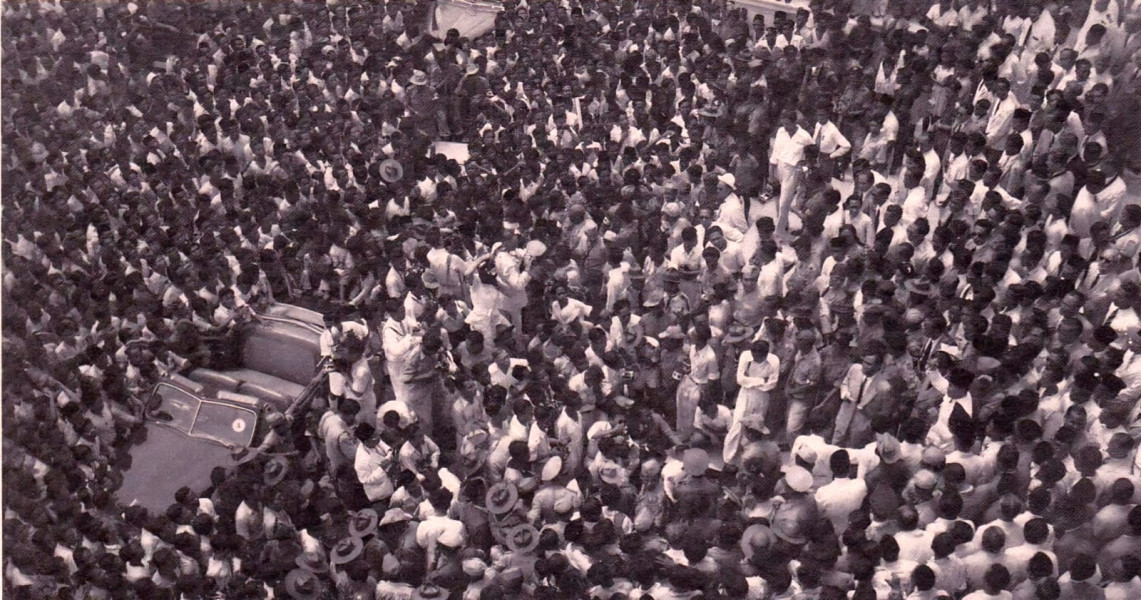
The song created in the early 1950s is very close to the condition of the city of Jakarta after the Recognition of Sovereignty on December 27, 1949, where Jakarta became the capital city again after having to move to Yogyakarta for about 4 years. As a symbolic city of independence, Jakarta became a magnet for people to flock to visit or even settle in Jakarta. It is only natural that the city, which was previously a symbol of a colonial city with tyrannical power that had been entrenched for so long, suddenly transformed into a symbol of freedom.
The wave of urbanization towards Jakarta cannot be stopped, which is understandable when the transition of the mindset and soul of the colonized has not gradually disappeared, compounded by the still chaotic conditions in all sectors after the war. Directing the goal to the capital was the most sensible choice at that time. Throughout the 1950s, many policies of President Sukarno required labor to revive the pulse of the capital.
The results of the Round Table Conference, which gave Indo-Dutch people in Indonesia the choice to choose Indonesian citizenship or leave for the Netherlands, indirectly reduced the number of skilled workers in several fields that could not yet be filled by domestic human resources. The nationalization policy of government and private assets during the Dutch East Indies era resulted in vacancies left by Indo-Dutch employees.
The condition of the capital that needed development driving forces attracted the interest of new arrivals. The completeness of the capital's facilities and infrastructure is also reflected in the verses that state how complete the capital is with various dynamics and social realities. Verses such as “the road bends if it bends hit by a rickshaw”, “Jakarta is always crowded morning, noon, and night”, “the highway is crowded with pedestrians”, “the beggar and the millionaire both put on a show”, “Don’t bend if it bends hit by a tram”, depict how complete yet complex the atmosphere of Jakarta is. From the perspective of newcomers, the situation seems to be the basis of desire rather than reluctance, wanting to witness the atmosphere of the free city firsthand. Other verses such as “in Jakarta stands a Statue Building”, “on Sundays, people from Jakarta go to Cilincing, a beautiful bathing place for fishermen”, “a famous place in Jakarta is the zoo” illustrate that various tourist and entertainment attractions are available in Jakarta.
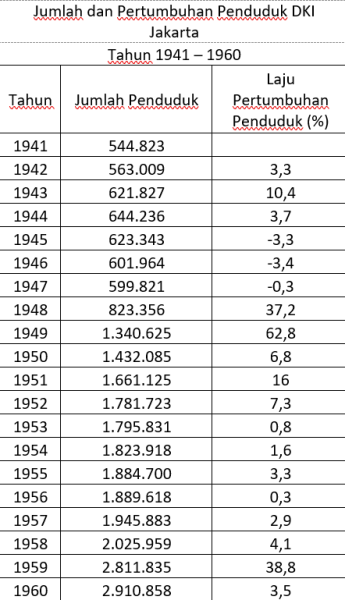
The string of verses becomes an invitation for people outside Jakarta to come and enliven the capital city. Formal sectors are certainly the main targets, although informal sectors such as services and trade also require more entrepreneurs. Referring to the population table of DKI Jakarta 1941-1960, a significant increase in urbanization occurred in 1948, 1949, and 1959. In those years, the aftermath of the wave of repatriation of Indo-Dutch people to the Netherlands left a void in the workforce in the capital Jakarta.
The disparity in development since this republic was established has made people leave their hometowns to seek fortune while experiencing the hustle and bustle of the newly growing metropolitan city that has become the focus of international attention. Mudik activities during the holidays also began to occur during this period for the same reasons and continue to this day, endlessly and continuing indefinitely.
Happy gliding back to your hometown.
References
Blackburn, Susan. 2011. Jakarta: A 400-Year History. Jakarta: Komunitas Bambu.
Dumadi, Sagimun Mulus. 1988. Jakarta from the Water's Edge to the Proclamation City. DKI Jakarta Government Museum and History Office.
Juliyansah, et al. No Year. Ethnomusicology Study of the Alo’ Galing Musical Instrument in Sambas District, Sambas Regency. Study Program of Dance and Music Education, Faculty of Teacher Training and Education. Tanjungpura University, Pontianak
KSS DKI Jakarta: Jakarta in Figures 1984
Pelana, Zulkifli. 2017. "Ismail Marzuki (1931 – 1958): Musician of Romantic Songs". Thesis. Jakarta State University.
Syahbani, Tanty Aulia. 2022. Ismail Marzuki: Composer of 3 Eras (1931-1958). Thesis. Jakarta State University.
Zuhdi, Susanto. 1995. Jakarta City of Struggle: Jakarta Proclamation City January 1945-January 1946. Jakarta: Special Capital Region Government of Jakarta.