



Kirab Kebo Bule: A Symbol of Javanese Culture Since the Islamic Mataram Era

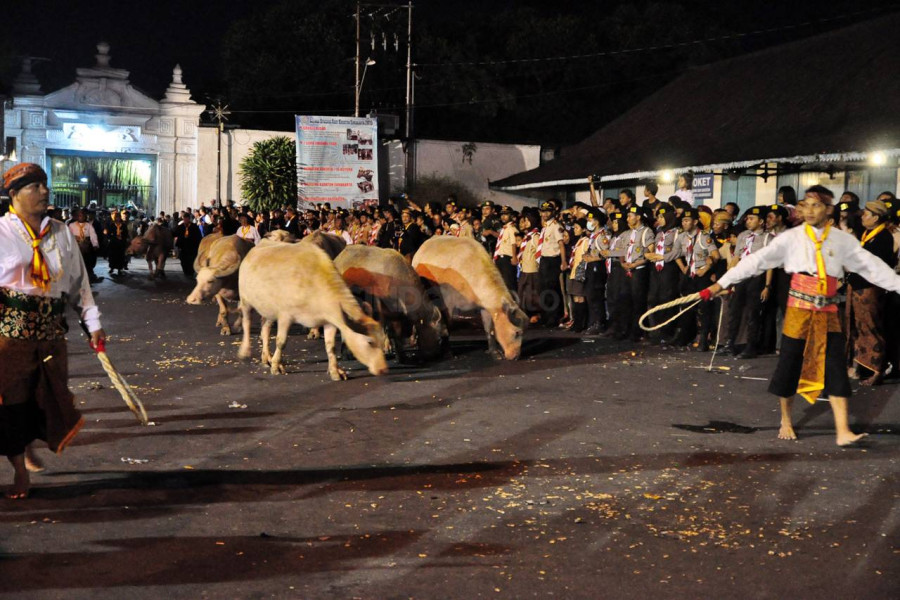
Every 1 Suro or 1 Muharram, the Keraton Kasunanan Surakarta holds an annual event called Kirab Malam 1 Suro. This event is a tradition of parading the royal heirlooms as a marker of the new year according to the Javanese calendar. The month of Suro in Javanese culture is considered a sacred month full of blessings, especially for the royal environment. Therefore, the tradition of Kirab Malam 1 Suro continues to be carried out to this day as a way to draw closer to God Almighty to seek safety as they enter the new year.
The tradition of celebrating Malam 1 Suro has actually been practiced since the Islamic Mataram Kingdom led by Sultan Agung Hanyakrakusuma, who also created the Javanese calendar system. During Sultan Agung's time, the celebration of Malam 1 Suro was more reflective without the procession of heirlooms (Purnamasari & Utari, 2015). Meanwhile, the Kirab Malam 1 Suro with the procession of royal heirlooms along with Kebo Bule Kyai Slamet was only conducted by the Keraton Kasunanan Surakarta (a branch of the Islamic Mataram Kingdom) under the leadership of Sunan Pakubuwono XII (Muthoharoh, 2022).
In the Kirab Malam 1 Suro conducted by the Keraton Kasunanan Surakarta, the royal heirlooms to be paraded have been purified (dijamasi) beforehand. After that, the royal heirlooms are paraded around the palace, escorted (cucuk lampah) by a group of Kebo (White Buffalo) Bule, which are the klangenan or favorites of the king. Generally, there are 7 of them (2 male buffalo and 5 female buffalo) (Muthoharoh, 2022; Purnamasari & Utari, 2015). Before being paraded to escort the royal heirlooms, Kebo Bule are bathed or dijamasi with flower water. After the Wilujengan Haul or communal prayer, Kebo Bule are taken by the pangon (herder) to the palace yard to be lined up with the royal heirlooms that will be paraded. The position of Kebo Bule is always at the front, intended not only as the foremost escort symbolizing safety but also as a marker that its nature as an animal that assists human work must be in front of the humans controlling it (Purnamasari & Utari, 2015).
The Kebo Bule owned by the Keraton Kasunanan Surakarta, known as Kyai Slamet, is a gift (pisungsung) from Adipati Ponorogo, Surobroto, to Sunan Pakubuwono II when he fled to Ponorogo due to the Geger Pecinan around 1742 at the Kartasura Palace (Rudianto et.al, 2020). While in Ponorogo, Sunan Pakubuwono II met his brother Pangeran Kalipo Kusumo, who then suggested he meditate under the twin sapodilla tree (sawo sak kembaran) south of Mount Bayangkaki (Hudaya, 2019). During his meditation, Sunan Pakubuwono II received guidance about a spear-shaped heirloom named Kyai Slamet that could bring prosperity to the kingdom. However, this heirloom had to be escorted by a pair of white/albino buffalo (kebo bule) when returning to Kartasura.
Adipati Suroroto, who learned of this, then presented a pair of kebo bule to Sunan Pakubuwono II (Lalita, 2018). Supernaturally, the heirloom Kyai Slamet disappeared and merged with the body of kebo bule. Sunan Pakubuwono II's entourage then returned to Kartasura with the Kyai Slamet heirloom merged with kebo bule. In short, Pakubuwono successfully reclaimed the Kartasura Palace from the Chinese rebels thanks to bringing Kebo Bule Kyai Slamet. It is even said that when moving the palace to Desa Sala in 1745, the kebo bule was intentionally released to graze. The location that is now the Keraton Kasunanan Surakarta is believed to be the place where the kebo bule stopped to graze.
Kebo Bule Kyai Slamet has been passed down through generations, both directly and indirectly, showing its influence and providing prosperity to the Keraton Kasunanan Surakarta and its people to this day. As an ancient cultural institution that still carries out its ancestral traditions, the Keraton Kasunanan Surakarta makes the Kirab Kebo Bule on the night of 1 Suro a symbol to pray to God Almighty for safety and prosperity for the nation, the state, and all its people. Kebo Bule Kyai Slamet has also inspired the creation of a new art form in Ponorogo called Kesenian Kebo Bule. This art aims to serve as a medium for Islamic preaching and to preserve the history of the journey of Sunan Pakubuwono II's entourage when fleeing to Ponorogo until obtaining the heirloom and kebo bule.
References
Purnamasari, R. A., & Utari, P. 2015. The Phenomenon of Kebo Bule Kyai Slamet in the Kirab 1 Suro of the Keraton Kasunanan Surakarta. Communication Science Study Program, Faculty of Social Sciences and Political Science, Universitas Sebelas Maret Surakarta.
Lalita, Yohana M. 2018. Risk Management of the Kirab Pusaka Tradition on Malam 1 Suro of the Surakarta Palace. Journal of Arts Management. Vol. 4 (1). Pp. 8-18.
Hudaya, S. et.al. 2019. The History of Kebo Bule Kyai Slamet in the Surakarta Palace Volume I. Ponorogo: UM Ponorogo Press.
Rudianto, et.al. 2020. Tracing the History of Kebo Bule “Kyai Slamet” in the Surakarta Palace and the Birth of Kesenian Kebo Bule as a Media for Islamic Preaching in Ponorogo. Sebatik. Vol. 24(2). Pp. 240-252.
Muthoharoh, Ika. 2022. Spiritual Meaning in the Celebration of Kirab 1 Suro (Keraton Kasunanan Surakarta). Thesis. Study Program of Ushuluddin Faculty, Syarif Hidayatullah State Islamic University.