



Kenduri Swarnabhumi: A Role Model for Sustainable Cultural Development Post-Pandemic

Jakarta - The effects of the Covid-19 pandemic have been drastic. It has impacted health, the economy, and humanity. Tens of millions of people have been infected and required medical attention. Unemployment peaked, leading to mutual suspicion among communities, reducing interactions due to fears of virus transmission.
However, one thing that should not be overlooked in the aftermath of the Covid-19 pandemic is the erosion of cultural spirit and values. This raises the question: did the pandemic really 'knock down' culture? In what ways has the pandemic affected culture?
A report titled Culture in Times of COVID-19: Resilience, Recovery and Revival released by UNESCO and the Abu Dhabi Department of Culture and Tourism last June revealed that during 2020, the cultural sector lost 10 million jobs and experienced a 20-40 percent decline in revenue.
Cultural projects also saw a reduction in added value of up to 25 percent. The minimal interaction between countries due to the pandemic disrupted the production and distribution of cultural goods and services, for example, 64 percent of freelance cultural workers in Latin America lost 80 percent of their income.
In June 2021, UNESCO reported that 13 percent of museums and cultural galleries worldwide had to close due to activity restrictions. Of course, this situation also eliminated workspaces for cultural practitioners.
In Indonesia, research compiled by the Ministry of Education, Culture, Research, and Technology (Kemendikbudristek) in August 2021 indicated that 65 percent of national cultural practitioners were no longer working. This factor affected income reduction by up to 70 percent. Furthermore, 70 percent of art spaces and cultural organizations were inactive.
The situation in Indonesia was further compounded by the cessation of national cultural art festivals, traditional performances, and local tradition showcases due to gathering restrictions to prevent the spread of Covid-19.
Referring to EB Taylor, culture is the feeling of a nation encompassing knowledge, beliefs, morals, arts, laws, and customs acquired from interactions among community members. Thus, the diversity of culture in the homeland can be seen as a reflection of the authentic attitudes and feelings of Indonesia, derived from past heritage and should be sustainably revived.
Pioneers of Cultural Development
Entering 2022, the pandemic situation began to be controlled – although it has not ended – and the trend of its spread decreased. This improving condition can serve as a momentum to reignite the spirit of the cultural sector.
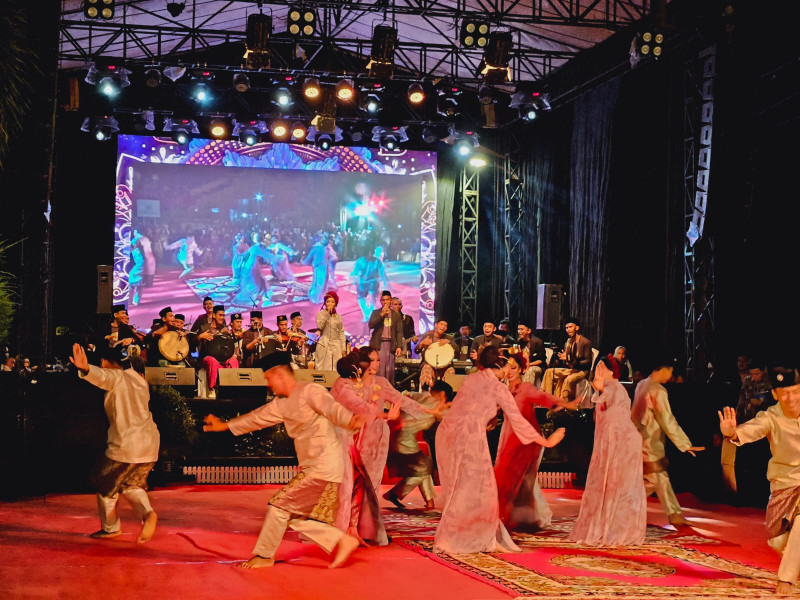
This step has been demonstrated by Kemendikbudristek by organizing several cultural events. One of the latest is Kenduri Swarnabhumi 2022, which took place in West Sumatra and Jambi, along the Batanghari River Basin.
Kenduri Swarnabhumi 2022 can be described as an effort to promote culture to remember, preserve, and rediscover various cultural civilizations within the aquatic Malay tradition, especially in Jambi Province.
Based on various documentation and news reports, as well as direct observations, Kenduri Swarnabhumi successfully encouraged the community to recognize the importance of the Batanghari River as a source of local wisdom that has endured to this day. Each region traversed by the Batanghari River held its traditional performances.
Interestingly, the series of Kenduri Swarnabhumi was packaged as an expedition team journey along the Batanghari River to investigate cultural heritage objects from the past that are part of national historical wealth. The implementation of Kenduri Swarnabhumi 2022 involved collaboration among stakeholders, namely Kemendikbudristek and local cultural heritage owners, including local governments and communities.
Local governments and communities were granted autonomy to showcase all their cultural attractions. This led to a cultural freedom where local governments and communities could creatively express their aquatic Malay customs.
This is what Louise Kelly and Chris Booth refer to as cultural synergy. It forms a harmonization of direction and operations of organizations that were previously separate, now integrated for the sake of culture. The central government (Kemendikbudristek), local governments, and communities united to disseminate cultural values for progress.
From the Kenduri Swarnabhumi 2022 event, a “common thread” can be drawn regarding the efforts to raise awareness of preserving and advancing culture. The state – in this context, Kemendikbudristek – is present to stimulate other parties (local governments and communities) to build culture. The state is not indifferent to cultural development.
Kemendikbudristek's support for the regions aims to ensure that cultural development continues sustainably in the future. Eventually, there will be a growing awareness among regions to independently initiate various cultural wealth festivals. Thus, cultural development never stops because of the recognition of the importance of ancestral heritage in creating the civilization they experience today.
This awareness is expected to automatically give birth to human resources (HR) that are pioneers of cultural development. Pioneer HR capable of formulating cultural development strategies through various works, innovations, and creativity. The mandate of Law No. 5 of 2017 on Cultural Advancement will continue to revolve because Indonesia has pioneering HR that is committed to preserving its traditional wealth.
Mutual Cooperation Showcasing Culture at Every Point
Kenduri Swarnabhumi was held by the Ministry of Education, Culture, Research, and Technology (Kemendikbudristek) together with 14 local governments, namely the Provincial Government of Jambi, the Provincial Government of West Sumatra, the District Government of Batanghari, the District Government of Bungo, the District Government of Dharmasraya, the City Government of Jambi, the District Government of Kerinci, the District Government of Merangin, the District Government of Muarajambi, the District Government of Sarolangun, the District Government of Sijunjung, the District Government of Tebo, the District Government of Tanjung Jabung Barat, the District Government of Tanjung Jabung Timur, and thousands of community members, cultural practitioners, artists, archaeologists, researchers, historians, communities, and students.
Kenduri Swarnabhumi, which carries the narrative Connecting Back the Communities of the Batanghari River Basin, serves as a platform for disseminating information through various physical and non-physical cultural activities in the areas along the Batanghari River Basin with the aim of advancing culture and raising community awareness about the harmony of rivers and civilizations that are increasingly important to be preserved with culture-based wisdom to maintain the ecosystem in the Batanghari River Basin.
Kenduri Swarnabhumi began at the upstream of the Batanghari River, namely in Dharmasraya Regency, which is located in West Sumatra Province. Kenduri Swarnabhumi, as a series of cultural festivals, began with the Pamalayu Festival, which became the first cultural festival held and visited by the Batanghari Expedition team.
In addition to being a cultural festival and a celebration for the people of Dharmasraya Regency, the Pamalayu Festival is also intended as a local government effort together with the community and cultural practitioners to correct the history that the arrival of the Singosari Kingdom delegation from Java through the Pamalayu Expedition to the Dharmasraya Kingdom was a diplomatic or friendship agenda between the two kingdoms. The correction of history was made due to the narrative that developed that the Pamalayu Expedition was a conquest of the Singosari Kingdom over the Dharmasraya Kingdom.
The people of Dharmasraya have passed down the story of the diplomatic relationship conducted by the Pamalayu Expedition delegation to various others. The solidarity of the community with various practitioners is clearly visible in the enthusiasm of the people towards the Pamalayu Festival, which is held annually. People from various districts flock to attend wearing traditional attire, and many also arrive using river transportation. The Pamalayu Festival concluded with a musical drama performance telling the story of Dara Petak and Dara Jingga, where all the drama actors consisted of various art groups from Dharmasraya and its surroundings.
The second stop of the Batanghari Expedition team was at the Pamuncuk State Festival held in Tebo Regency, which also saw enthusiastic participation from the community and various stakeholders. At this point, the spirit of mutual cooperation was evident in the State Assembly and the culinary offerings presented. The State Assembly is a deliberative activity among community leaders discussing various issues and solutions for the future in the local area. The State Assembly is conducted using traditional attire and local language. This is done routinely every year to preserve the cultural values of the community.
The spirit of mutual cooperation is also reflected in the signature cuisine of Tebo Regency, namely Gulai Kuning Ikan Nila and Nasi Ibat. All the dishes served for festival participants are produced en masse by local women with the costs covered independently.
The third stop of the Expedition team was at the Bumi Seentak Galah Serengkuh Dayung Festival, also in Tebo Regency. At this festival, the spirit of mutual cooperation was prominently displayed by school students and teachers along with cultural practitioners. All students showed enthusiasm in participating in the cultural festival, and various cultural performances were conducted by groups consisting of students from various regions.
The Expedition team continued their journey along the Batanghari River until they reached Batanghari Regency, specifically at the Tapa Malenggang Festival, held at the old market that still stands strong. Although this market consists of people from different ethnic backgrounds such as Arab, Chinese, Malay, and Indian descent, solidarity and pluralism are very strong in this area. The cultural performances showcased various ethnicities. Finally, the Batanghari Expedition team was treated to a lion dance performance by the local Chinese ethnic community.
Not stopping in Batanghari Regency, the Batanghari Expedition team again witnessed the spirit of mutual cooperation in the Jambi Seberang area, Jambi City. Here, the cultural festival held was the Tudung Lingkup Festival. At this festival, over 1,000 women from various districts covered their heads with their respective batik or songket cloth as a requirement to participate in the tudung lingkup parade.
After concluding in Jambi City, the series of Kenduri Swarnabhumi continued to Bungo Regency with the Lek Anak Negeri Festival and Sarolangun Regency with the Lapik Semendo Festival. The Lek Anak Negeri Festival serves as a tradition for the Bungo community related to religious rituals, including tolak balak, thanksgiving, and oath-taking. The spirit of mutual cooperation at this festival is demonstrated by the solidarity of the local community in providing various food offerings with costs collected from each resident.
At the Lapik Semendo Festival, the spirit of mutual cooperation is depicted in preserving the unique cultural product of Sarolangun, namely woven mats. These woven mats are routinely used in various traditional events such as welcoming guests and weddings. This is done as a promotion of local products that can drive the local economy.
Similar to other regions, after the Batanghari Expedition team arrived at Senaung Village in Muaro Jambi Regency during the Sedekah Senaung Festival, solidarity was shown through the culinary offerings presented and the Lubuk Larangan that is still preserved. Lubuk Larangan is a part of the river designated by the local community to not exploit its resources as an effort to sustain the river. Fishing in the lubuk larangan is done on certain days, usually during traditional festivals.
Still in Muaro Jambi Regency, the Batanghari Expedition team participated in the Renjana Swarnadwipa Festival. This festival was held in the National Cultural Heritage Area (KCBN) of Muaro Jambi as an effort to promote and draw back the attention of the Jambi community to the existence of the temple complex that holds high historical value. From the information gathered, the KCBN Muaro Jambi was discovered and restored by the local community in collaboration with relevant stakeholders.
The cultural expedition of the Batanghari team concluded at the estuary of the Batanghari River - the meeting point between the river and the sea located in Tanjung Jabung Timur Regency, specifically at the Lawang Swarnabhumi Festival. Lawang means door, referring to the entrance of the Batanghari River. The Lawang Swarnabhumi Festival was no less festive, with the local community and regional government collaborating, also involving 57 companies in the regency.
At the Lawang Swarnabumi Festival, a miniature golden ship was placed as a symbol of the Batanghari Expedition that was signed by various involved governments. This miniature ship serves as a monument to remind the community to continue preserving the Batanghari River.
The final traditional performance attended by the Batanghari Expedition team was the Mandi Safar held in Hitam Laut Village, Tanjung Jabung Timur Regency. Mandi Safar is a local ritual performed as a demonstration of gratitude for the blessings of nature. Initially, Mandi Safar was conducted individually at home, but to strengthen social ties and maintain local cultural values, the community held Mandi Safar together at the black sea.
In line with its slogan 'Love Our Culture, Preserve the River, Love Our River, Preserve Culture', the narrative of Kenduri Swarnabhumi strongly emphasizes and invites the community to continue preserving local wisdom and protecting the river environment, which is the cradle of cultural civilization. However, in its implementation, Kenduri Swarnabhumi offers something else, namely the spirit of mutual cooperation. By holding a series of cultural festivals at various points, all communities and other stakeholders are motivated to contribute to the success of Kenduri Swarnabhumi.
Kenduri Swarnabhumi is a role model of how cultural festivals can revive and strengthen the spirit of togetherness.