



National Archaeology Day 2026: Understanding Cultural Heritage from Our Surroundings

Every region has a story. Some are passed down through traditions and the collective memory of the community, while others are preserved and inherited through museums, archaeological sites, historical buildings, inscriptions, and cultural heritage areas that we can still encounter today. Through the theme "Museums and Cultural Heritage in My Region", National Archaeology Day 2026 invites the public to revisit the cultural heritage around them as an important part of the nation's identity and journey.
Often, archaeology is understood as something distant from daily life, as if it can only be found in famous sites or studied by experts. In fact, almost every region in Indonesia has its own historical traces and civilization. These traces come in various forms, from archaeological sites, temple complexes, historical buildings, regional museums, to cultural objects that bear witness to the journey of local communities. The presence of this cultural heritage shows that history does not only live in textbooks but is also around us and becomes part of the living space of contemporary society.
In this context, museums and cultural heritage play a very important role. Both serve as a bridge connecting the past with the present. Through the collections stored and the information presented, the public can understand how life has evolved over time. Objects that may seem simple, such as stone tools, pottery, statues, or inscriptions, actually hold valuable information about technology, beliefs, social systems, and human adaptability to their environment. Museums and cultural heritage sites not only function as storage places for artifacts but also as learning spaces that allow the public to recognize their historical roots while understanding the long process of civilization formation.
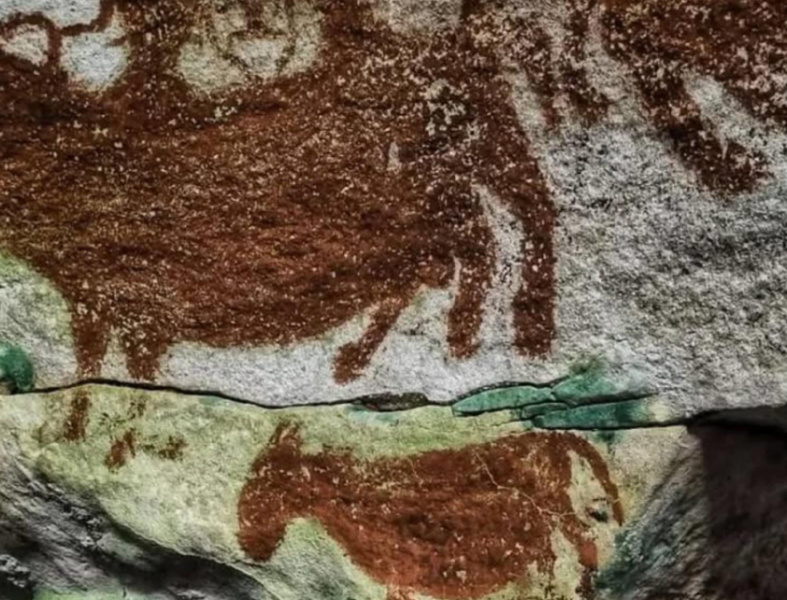
Understanding of the past continues to evolve alongside research conducted by experts. Amidst the changing times, Indonesia's cultural heritage continues to present new knowledge that enriches our understanding of human journeys. One of the findings that attracted global attention is the research published in 2026 regarding handprint paintings in the Liang Metanduno Cave, Muna Island, Southeast Sulawesi. These rock paintings are estimated to be at least around 67,800 years old and are among the oldest non-figurative artworks ever discovered. This finding indicates that the Indonesian region has been a space for human creativity for tens of thousands of years and reinforces the position of the archipelago as an important area in the history of the development of prehistoric human art.
This finding complements previous research in the Maros-Pangkep karst area, South Sulawesi, which revealed the existence of narrative paintings approximately 51,200 years old. These paintings are considered one of the oldest pieces of evidence of human ability to compose stories through images. Both findings illustrate that humans living in the archipelago during prehistoric times were not only capable of survival but also possessed symbolic thinking, imagination, and the ability to express their ideas through art.
The long journey of the archipelago's civilization did not stop in prehistoric times. Entering the megalithic tradition, various cultural remnants show how ancient societies began to build ritual spaces and symbols that reflect their belief systems. One important example is the Gunung Padang Megalithic Site in Cianjur Regency, West Java. This site, which has been designated as a National Cultural Heritage, is known as the largest stepped punden complex in Southeast Asia and is one of the most famous megalithic sites in Indonesia.
Gunung Padang demonstrates how a cultural heritage site can continue to provide research space as well as learning opportunities for the community. Various archaeological, geological, and geophysical studies have been conducted to understand the history of the site's formation. Although several aspects regarding its age and construction process remain subjects of scientific discussion, Gunung Padang showcases the vast potential of Indonesia's cultural heritage, which still holds much information about the lives of past communities. The presence of this site also reminds us that cultural heritage does not belong solely to researchers but is a shared legacy that can serve as an educational tool and strengthen the cultural identity of the community.
The traces of the archipelago's civilization then became increasingly complex during the Hindu-Buddhist kingdoms. Various studies and excavations conducted in East Java in recent years show that there is still much knowledge to be uncovered from sites long known to the public. Excavations in the Brahu Temple area, Trowulan, Mojokerto, for example, discovered ancient fence structures and sacred spaces indicating the existence of a broader religious complex than previously known. Meanwhile, research at the Adan-Adan Site in Kediri Regency revealed various artifacts such as Buddha statues, stupa fragments, and architectural components indicating the presence of an important religious activity center in the past.
These findings illustrate that cultural heritage is not merely a silent and unchanging relic. On the contrary, each site and museum collection still holds the potential for knowledge that can be continuously explored to understand the development of society over time. From rock paintings in Sulawesi, megalithic traditions in West Java, to temple complexes in East Java, all are part of the larger mosaic of the archipelago's history that is interconnected.
The awareness of the importance of cultural heritage is the spirit of National Archaeology Day 2026. The protection efforts undertaken by the government through the designation of hundreds of National Cultural Heritage sites in recent years demonstrate the immense cultural wealth that Indonesia possesses as well as the importance of sustainable preservation efforts. However, preservation cannot be carried out by the government and experts alone. Community involvement is the key to the sustainability of museums and cultural heritage.
Visiting local museums, participating in cultural education activities, studying local history, and maintaining the cleanliness and preservation of sites are tangible forms of participation that anyone can engage in. The theme "Museums and Cultural Heritage in My Region" ultimately invites us to start from what is closest. Cultural heritage is not always far from daily life. Around us, there are museums, historical sites, historical buildings, and cultural heritage areas that hold stories about the journey of local communities. By recognizing and visiting cultural heritage in our respective regions, we not only learn about the past but also understand how regional and national identities have formed over time.
In the end, preserving museums and cultural heritage is not just about caring for the relics of the past. More than that, these efforts represent a responsibility to maintain the collective memory of the nation. Through cultural heritage, we can understand the long journey of the archipelago's civilization, appreciate the achievements of past generations, and pass on valuable knowledge to future generations. Because behind every artifact, site, and historical building lies a story about who we are, where we come from, and how Indonesian culture continues to evolve to this day.