



Peh Cun Festival: Cemar Chatter at Cisadane

Talking about civilization involves discussing space, land, and its elevation from sea level, climate, surrounding flora and fauna, natural opportunities and conveniences, as well as human actions in facing these basic situations and conditions - agriculture, livestock, food, shelter, communication, crafts, and so on. The life of river communities is largely determined by the character of the river in question. The overflowing of water at certain times requires the community to cooperate to mitigate the threat of flooding (for example, by building levees). Efficient cooperation requires a resilient community organization with a high level of concern for the common good. Therefore, certain regulations are established to govern community life. River communities do not always view floods as a disaster. Agricultural communities see them as carriers of fertile soil from mountainous areas. The alluvial regions that settle downstream contain good soil for agriculture that can produce enough food for the ever-increasing population. The food surplus generated by fertile land and advanced agricultural technology innovations allows river civilizations to exchange it for goods needed from outside areas (Lapian, 2008).
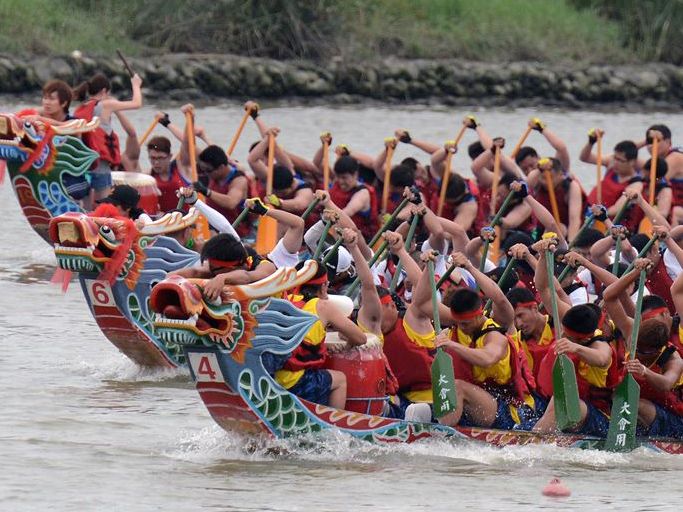
The Cisadane River in Tangerang, when associated with Chinese culture, has a unique tradition, namely Peh Cun. Peh Cun is one of the major ethnic celebrations of the Chinese descendants that falls on the fifth day of the fifth month (go gwee cee go) in the Lunar New Year. The Peh Cun tradition refers to the legend of a nobleman during the Couw Dynasty (340-278 BC), who was also a great writer and cultural figure, namely Khut Goan. This tradition is also identical to the Dragon Boat Festival on the Cisadane River in Tangerang City. Peh Cun is a summer festival that has become a tradition in China and is also celebrated by Chinese descendants in Tangerang. Etymologically, Peh Cun consists of two words: peh meaning paddle or to paddle; and cun meaning boat. So literally, Peh Cun means paddling a boat. In its implementation, the highlight of the Peh Cun tradition is indeed the decorated boat race (Rosyadi, 2010).
Some traditions commonly performed during the Peh Cun celebration include: a. Beating drums and setting off firecrackers. b. Positioning eggs to stand upright, precisely at noon (12:00 PM) on Peh Cun day, it is believed that eggs can stand upright on one of their pointed sides. This is due to the attractive force between the sun and the earth, which can make the eggs stand. c. Drying collections of clothes, fabrics, and old books. d. Hanging leaves such as sudamala leaves, deringo leaves, young rice leaves, banyan leaves, and a zongzi tied with red thread, placed on the main door frame of the house. These leaves are believed to be very effective in warding off poisonous animals and spirits that will disturb human tranquility. e. From 11:00 AM to 1:00 PM, people celebrate Peh Cun by drinking rice wine mixed with hiong-hong, bathing in warm water infused with lam hoa flowers, which are believed to ward off diseases. f. Noon on Peh Cun day is believed to be a very good time to harvest plants for medicinal purposes. According to Chinese medicine experts, on that day the earth's air and the sky's air meet and unite, allowing everything that grows on earth and water to be infused with that air. g. This time is also believed to be a good moment to cut wood or bamboo that will be used as building materials (Rosyadi, 2010).
The IndonesianaTV Cultural Channel aims to preserve and promote Indonesia's diverse culture to the wider community, both domestically and abroad, through the airing of programs that highlight various aspects of Indonesian culture, such as arts, customs, traditions, and history. The IndonesianaTV Cultural Channel seeks to enhance public knowledge and awareness of Indonesian culture through the airing of educational and informative programs that are packaged attractively and are easy to understand by all groups.
Cultural content related to the traditions of the Chinese Ethnic group associated with the river as a center of civilization currently available on the IndonesianaTV platform is “Peh Cun”. A documentary about the Peh Cun Celebration Day. The activities of the community around the Cisadane River are beginning to be seen preparing for the celebration. In the preparation for Peh Cun, Jensen and his friends are seen enthusiastically helping to decorate the boats for the competition in this year's Peh Cun celebration. They do not want to appear unprepared on the peak day of the celebration later.
The cultural content available on the IndonesianaTV Cultural Channel is a form of good practice that is expected to provide educational information that ultimately leads to the realization of Indonesian culture that remains sustainable and serves as a guide for future generations.
Rivers, from upstream to downstream, are an important source of life for various living beings. Rivers do not only belong to humans; many animals and plants, as well as other living beings, make rivers their habitat. For humans living along the riverbanks, the river is the lifeblood of their existence. Their survival and well-being depend on the river. Not only as a means of transportation and fulfilling daily needs, the surrounding community also relies on the river as an economic source. However, development around forests that does not consider water catchment areas disrupts river ecosystems. This leads to erosion, sedimentation, and pollution. The era of industrialization that ignores the safety of existing ecosystems through pollution will gradually erode traditions that have long lived in the Cisadane River. Environmental destruction will not only eliminate living beings but also the traditions of a civilization.
References
Rosyadi, 2010. Peh Cun Festival: Tracing the Chinese Ethnic Tradition in Tangerang City. Patanjala Bulletin Vol. 2, No. 1, March 2010. Ministry of Culture and Tourism. Historical Preservation and Traditional Value Center Bandung.
Lapian, Adrian Bernard. 2008. The River as a Center of Civilization. Proceedings of the Brantas Watershed Change Seminar from a Historical Perspective. Department of Culture and Tourism. Directorate of Historical Geography. Directorate General of History and Antiquities.