



Fajar Siddiq: The Hope for Long-lasting Theater in Semarang

The city of Semarang always has its own story about theater. The theater practitioners in this Atlas City continue to light small candles to keep the space of imagination alive. The theater climate in Semarang is indeed not as vibrant as in other cities, such as Yogyakarta or Jakarta, but there is always a pulse that refuses to fade. This pulse emerges from small communities, cross-generational meetings, and the courage to continue staging works even though (usually) the audience is not always full. In recent years, alternative spaces have begun to be revisited by activists. They realize that if no one stages the stories, Semarang could lose an important dimension of its own civilization. So when Teding Teater emerged with its debut performance, the theater community in Semarang seemed to be given a reason to hope again.
Teding Teater chose the play "Fajar Siddiq" by Emil Sanossa as its debut. This is certainly not just a choice, but also presents a challenge. The script demands energy, character discipline, and technical courage. As the director, Nasrun M. Yunus did not work alone. He collaborated with Daniel Hakikie, Anton Sudibyo, A. Sofyan Hadi, Wikha Setyawan, and Imaniar Yordan, theater workers who each bring their own stage instincts. Their combination creates an atmosphere that this debut performance is not just a “new presence,” but a statement: that a new group also deserves to be part of the theater landscape in Semarang.
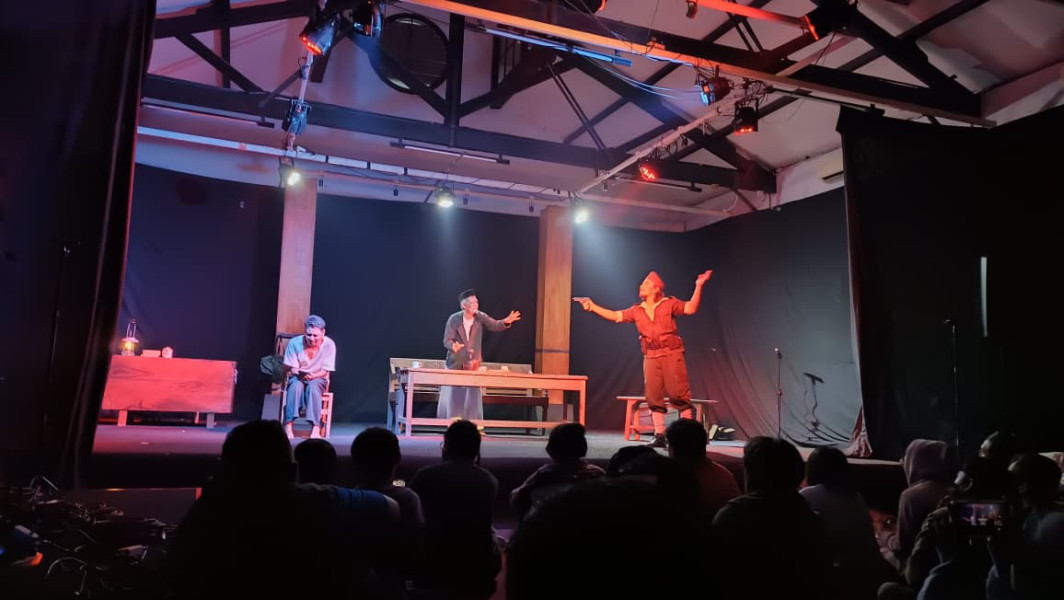
The performance was held at Gedung Oudetrap, one of the historical buildings with distinctive colonial architecture in the Old Town area of Semarang. Since 7:00 PM WIB, the audience began to arrive; some appeared to be “familiar faces” already acquainted with the scent of the stage, while others were new faces. By 7:30, the former spice warehouse built in the 18th century in 1834 was already full. Audience members from outside the city were also present. They sat mingling; on the red carpet, in several rows of chairs at the back, leaving an aroma of enthusiasm. Their eyes conveyed a classic question: “What kind of performance are we going to see tonight?”
The lights dimmed on stage. The MC's voice emerged softly, dampening conversations, organizing the atmosphere. On the red carpet, people immediately straightened their posture; while in the back seats, some leaned back to avoid reflections from their devices. The MC read the audience etiquette in a soft voice; a small ritual often overlooked in theater performances, but important to maintain the “purity” of the performance space.
As soon as the MC's voice faded, musical illustrations began to seep in. The music served as a hypnotic offer for the audience to focus on the performance stage. However, as an accompaniment, its duration felt quite long, slightly exceeding the dramatic needs of the opening. Some pairs of eyes exchanged glances, as if quietly asking: “Is this really part of the directorial intention?” Nevertheless, the music still left a pleasant harmony, giving the audience space to adjust their emotional waves before the performance of Fajar Siddiq truly ‘began’.
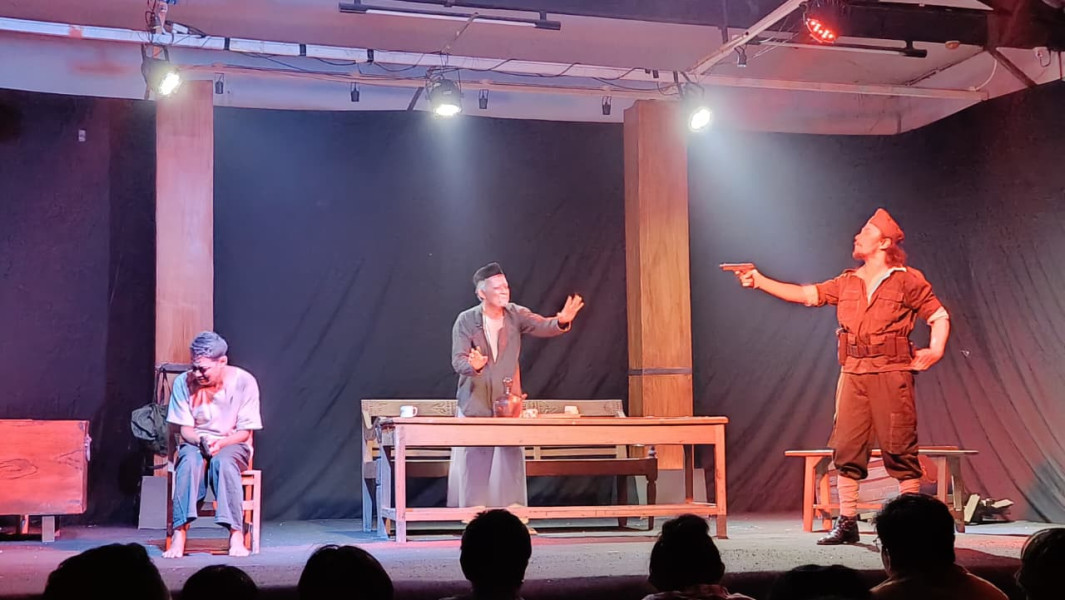
The music gradually faded. The lights began to illuminate the stage more firmly. The stage set seemed deliberately touched with simplicity but precision: a long table paired with chairs placed right in the center of the stage. On the right side, a small table with a lit lamp. This small detail actually created an intimacy in the space, as if inviting the audience into a past that has yet to be clarified. The dim yellow light from the lamp gave the impression that the story to come was not only about events but also about the questions that deserve to be awaited for answers.
Then appeared Marjoso, a freedom fighter who is also a student. His body stood upright, positioned directly under the spotlight. In an instant, the Oudetrap stage seemed to become a corridor of history and the stench of revenge. From the moment he appeared, the audience immediately knew that this character was bearing something heavy: struggle, anger, and perhaps also a loyalty that was nearly destroyed by betrayal. With measured gestures and articulation, he guided the audience into the world of Fajar Siddiq.
In this performance, one thing that stood out was the seriousness of the acting. The actors seemed to understand their space and bodies, working with maintained energy, and able to hold and release intensity according to the needs of the scene. No actor seemed to be left alone on stage; everyone entered and exited with a harmonious dramatic rhythm. This shows that their rehearsal process was not just a “walkthrough,” but truly crafted with care.
From the aspect of makeup and costumes, small details appeared quite well. Characters came to life not only from dialogue but also from how the costumes adhered to the actors and supported the story's background. Meanwhile, the musical illustrations worked as a mood enhancer. Although the opening song felt a bit longer, in other parts, the music was spot on, intensifying tension, softening reflective scenes, or thickening tragedy when conflicts reached their peak.
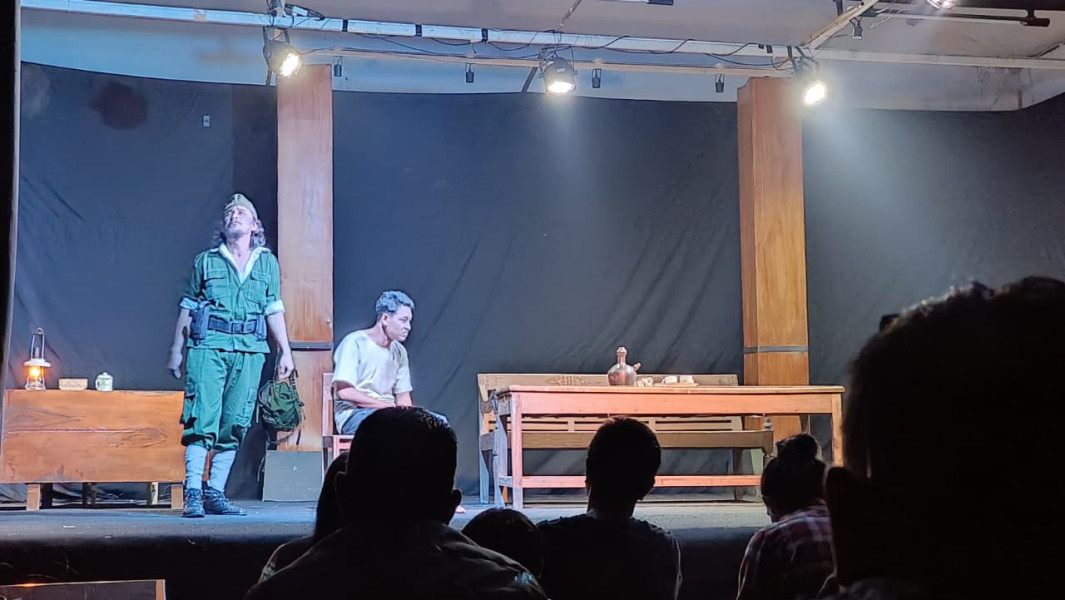
In the realm of lighting, the light play was quite safe. There were no major technical disruptions, just a slight misalignment for a few seconds when the spotlight should have focused on a character on the left side of the stage. However, this did not disrupt the overall flow, only causing a few technically sensitive audience members to frown slightly. Overall, the lighting successfully defined the space, emphasizing what should not be seen, and sharpening what needed attention.
As the performance neared its end, the lights gradually dimmed. The music returned, this time transforming into an atmosphere of bitterness. The performance concluded, and instantly applause erupted. The audience stood, signaling satisfaction and surprise. Not everyone came with the expectation that a new group like Teding Teater would present serious work. However, that night they left with renewed confidence.
This performance seemed to say; Semarang still has hope in its theater world. That this city still has people willing to nurture the imagination of the stage. That old buildings like Oudetrap still have cultural functions, beyond just being photo tourist spots, or merely evidence of colonial-era architecture.
Hopefully, “Fajar Siddiq” by Teding Teater is not just a remedy for the longing—longing of theater activists who have not seen serious works in their own city for a long time. But “Fajar Siddiq" should become a sign of a new awakening, a dawn that is truly “siddiq”: honest, upright, and glowing.
Semarang theater does not just need grand performances with luxurious decorations. It needs the courage to continue starting, nurturing, and maintaining consistency. That night, Teding Teater has begun it. Let us await the next theater works.