



Adaptive Culture in Facing the Industrial Revolution 4.0

Major leaps in the history of human civilization have spanned far since prehistoric times. The hunting culture transitioned into a gathering culture as an example of how humanity continuously adapts to change. It has become a necessity that humans often seek solutions to the life problems that afflict them. The demand for adaptation leads to how humans can adjust themselves to survive.
A significant change is based on the massive changes in needs that occur worldwide at any given time. It is undeniable; everything is just a matter of time. Whether it is a slow but certain evolution or a rapid and significant change that becomes a revolution.
The industrial revolution has occurred in about four stages, from industry 1.0, 2.0, 3.0, to the current industry 4.0. Revolution itself refers to a change in the cultural and social patterns present in society, as well as habits that are often performed related to the basic life of society briefly. Meanwhile, industry refers to activities related to processing raw materials into valuable or quality goods (Harahap, 2019 in Annisa 2021). The industrial revolution can also be interpreted as a fundamental change in the way humans work, as it gives rise to new things that can help and are also needed in human life (Setiono, 2019 in Annisa 2021).
The industrial revolution has also brought significant changes to human life. The first industrial revolution occurred by shifting production mechanisms to the invention of a machine, the second industrial revolution was at a stage where mass production was integrated with standardization, the third industrial revolution was a stage where mass alignment was emphasized on computer integration, and the fourth industrial revolution has introduced a collaboration between the internet and manufacturing, resulting in automation and digitization that are currently being experienced and implemented by humans in their lives (Suwardana 2019 in Annisa 2021).
Each period of the Industrial Revolution is always marked by innovations and new discoveries that lead to the development of technology to minimize the use of human labor that is too dominant. Business owners and capitalists always calculate the formation of production factors, how to minimize production costs as low as possible. In every period, there are always efforts to replace production factors, in this case, human resources. The involvement of human resources in the production flow gradually begins to decrease along with the innovative development of technology produced through massive research. The involvement of experts to design technological updates is not done quickly. In terms of costs, of course, capital owners need to dig deep into their pockets, which in valuation will disrupt operational costs in the short term but become a long-term investment.
On the other hand, human resources as a production factor, let's say workers. Do they understand their vulnerable position in a production chain? Is there a thought in their mindset that at some point, human labor in a production chain will no longer be needed in large numbers? Then where will they turn if human labor is no longer needed in a production chain? The demographic bonus that produces a new workforce does not correspond with the availability of job opportunities that are gradually being replaced by an automated operating system. If there has ever been a saying like "human life is like a robot" in human civilization, then the direction towards the new civilization of the Industrial Revolution 4.0 and 5.0, where everything is driven by robots, is no longer an impossible thing.
Will human civilization have reached its final chapter with an automated system that touches all aspects of life, creating a systemic dependence of humans on this advanced technology? Is the world revolution too fast, or are we too slow to respond to the situation? However, it all returns to the basic nature that humans are adaptive beings to all kinds of changes.
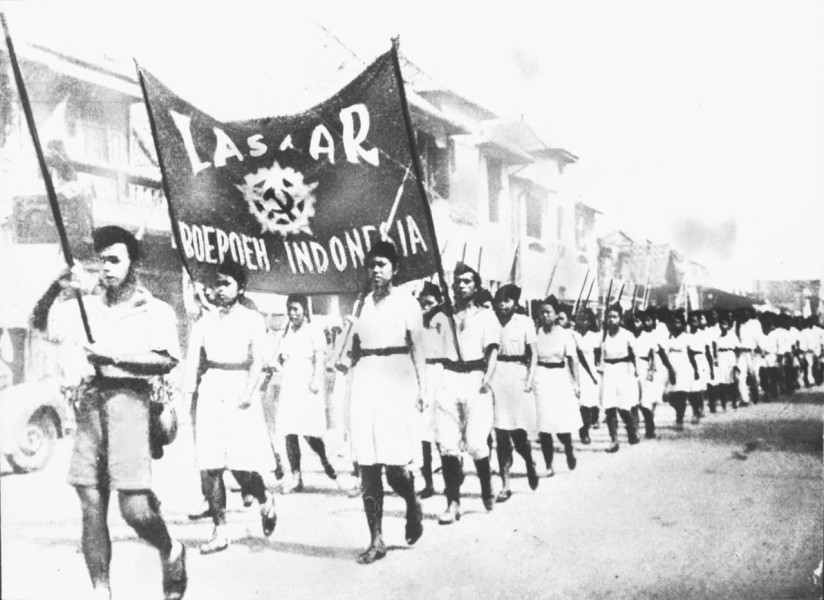
The famous slogan from Karl Marx and Friedrich Engels that has always been present in every celebration of International Labor Day since the past, "Workers of the World, Unite!" should be reflected upon and instilled not only in the working class and laborers but also in all of humanity to immediately sound the alarm for human civilization to become "Humanity of the World, Adapt!".
References
Harahap, N. J. 2019. “Students and the Industrial Revolution 4.0,” Jurnal ECOBISMA J. Ekonomi Bisnis dan Manajemen., vol. 6, no. 1, pp. 70–78, Sep. 2019
Setiono, B. A. 2019. “Enhancing Human Resource Competitiveness in Facing the Industrial Revolution 4.0,” Jurnal. Apl. Pelayaran Dan Kepelabuhanan, vol. 9, no. 2, p. 179, Dec. 2019
Suwardana, H., 2018. “The Industrial Revolution 4.0 Based on Mental Revolution,” Jurnal JATI UNIK. Jurnal Ilmu Teknologi dan Manajemen. Vol. 1, no. 1, p. 102, Apr. 2018