



Universal Language: Happy Emoji, Regional Language: Sad Emoji

Communication is an inseparable part of human life. Every sector in society requires communication, and language is the primary tool for communicating. Language serves as a medium/tool of communication used to provide or convey explanations to the interlocutor so that the conversation can proceed smoothly. Language is the heart of every communication, therefore it must be preserved and maintained in its integrity. With language, humans can socialize, exchange ideas, express thoughts, and interact easily (Arisandy et al., 2019)
Language functions as a tool to express feelings or to express oneself. Language also serves as a communication tool and as a channel for someone's intentions, which gives rise to feelings and enables society to cooperate. In addition to the above, language functions as a means of integration and social adaptation. When adapting to a social environment, a person will choose the language used depending on the situation and conditions faced (Daud, 2021)
As time goes by, the term cyber communication has emerged. Cyber communication is defined as communication conducted by utilizing cyber media. Nasrullah reveals three characteristics when cyber media becomes a medium of communication. First, the relationship or network is not only of the type of connection between individuals, but can also involve an unlimited number of individuals. Second, it facilitates interaction for any of its users. Third, it involves both hardware and software devices such as the internet (Panuju, 2018).
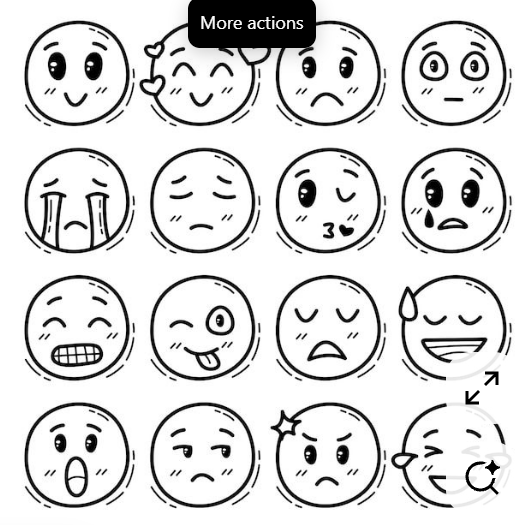
When we connect with each other through social media, we often encounter emojis used by others. When we enter the homepage of the application, many emojis are scattered to emphasize texts or images that are uploaded. The symbols used express various things such as facial expressions, fruits, animals, musical instruments, activities, or other symbols. Nahwiyyah & Dewi in 2020 stated that the use of emojis is to emphasize a statement and express feelings or moods. The use of emojis arises because users feel that verbal expressions are sometimes not enough to convey a message. The meanings of the symbols from emoticons can vary depending on the accompanying message, or externally depending on social, religious, cultural contexts, and so on (Abidin, 2016).
In the advancement of science and innovation of civilization, the presence of emojis can eliminate cultural differences. Emojis as message conveyers can be understood by all of humanity from various cultural backgrounds. Nonverbal language can unite perceptions in viewing a phenomenon. The emergence of emojis is part of the continuity of culture itself, where creative works and new innovations make human life dynamic. Happy emojis can depict
the achievements of progress in a civilization, but due to the overly dynamic nature of culture, the advancements obtained often overshadow, dilute, and even eliminate other cultures that will be replaced.
Sad emojis can be addressed to the fate of regional languages, the culture of pantun, and the like. If nonverbal language can be used to interact on social media, then how about the preservation of regional languages? The number of speakers of regional languages is gradually decreasing without the regeneration of new speakers from younger generations. The updates of emojis that appear at any time may shift the public's interest in knowing and learning new emojis to be perceived as individuals who are up to date, rather than learning and preserving cultures that will sooner or later be abandoned.
References
Abidin, Yanuar. 2016. The Meaning of Emoticon Symbols (Semiotic Analysis of Emoticon Symbols in WhatsApp Messenger During Chatting Activities of Muhammadiyah University Students in Ponorogo. Thesis. Communication Studies Program. Faculty of Social Sciences and Political Science. Muhammadiyah University of Ponorogo
Arisandy, D., Rizkika, D. P., & Astika, T. D. (2019). The Existence of Indonesian Language Among Millennial Generation in the Era of Industry 4.0. Indonesian Language and Literature Education, 3(2), 247–251. Garuda.Ristekbrin.go.id
Daud, R. F. (2021). The Impact of Communication Technology Development on the Indonesian Language. Interaction Journal: Journal of Communication Science,
Nahwiyyah, Rodiyatun & Eriyanti Nurmala Dewi. 2020. The Function of Emoticons as Nonverbal Language in Digital Communication”. In ProListik: Journal of Communication Science vol. 5, no. 2, Mar. 2022. Islamic University of Nusantara. Bandung.
Panuju, Redi. 2018, Introduction to Communication Science Studies: Communication as an Activity Communication as a Science. Jakarta, Paramedia Group.