



Indonesiana.TV as a Cultural Resource for Children

Looking back at the establishment of World Children's Book Day, which was officially recognized by the United Nations Educational, Scientific and Cultural Organization (UNESCO) in 1967, in honor of Hans Christian Andersen, the famous Danish fairy tale writer, taking the moment of his birth on April 2. At that time, the proclamation of World Children's Book Day aimed primarily to encourage reading interest among children. This noble goal was to eradicate illiteracy worldwide, especially with the emergence of new countries that had just gained independence from colonial rule, creating disparities in various sectors between third-world countries and developed nations in terms of access to library resources.
Times have changed, and the global environment has also evolved. The printing of books requires raw materials such as pulp derived from teak wood. The global paper industry continues to grow rapidly alongside the increasing demand for documentation and printed media. However, the conventional paper-making process often has negative environmental impacts (Nurmalasari & Mardikaningsih in Jannah et al., 2025). The demand for paper will continue to rise with the increase in education, business, and administration. Conventional paper production often uses teak wood, leading to environmental degradation. Advances in unrefined paper components are crucial to addressing this issue (Gunawan & Wijaya in Jannah et al., 2025). Teak leaves (Tectona grandis), which grow in many tropical regions, are a beneficial alternative. Dried and unused teak leaves can be processed into paper, creating a safe and easily maintained environment (Fitriana & Lestari in Jannah, 2025). By utilizing teak leaves as raw material for paper, we can reduce dependence on increasingly limited natural resources. This also supports efforts to preserve forests and maintain ecosystem balance (Ummah et al in Jannah, 2025).
If we look at the latest technological developments and the state of the environment in efforts to preserve human civilization impacted by climate change, the use of paper as a library material will gradually be abandoned for sustainability. The rapid development of cultural media in line with technological advancements encourages the need to transform library resources from books into digital and audiovisual formats. In accordance with the mandate of the Cultural Advancement Law, public access to reliable and credible knowledge sources about Indonesian culture, created with thoughtful wisdom, becomes essential. The existence of a special channel showcasing cultural content in a creative and inspiring format is intended to stimulate children's interest in knowledge about culture. Digital libraries will fundamentally change the forms of knowledge sources for children, aligning with the original reason for the proclamation of World Children's Book Day, which was to eradicate illiteracy and enhance children's literacy through books. However, the initial goal of the proclamation can still align with the transformation of knowledge sources that are no longer in book form.
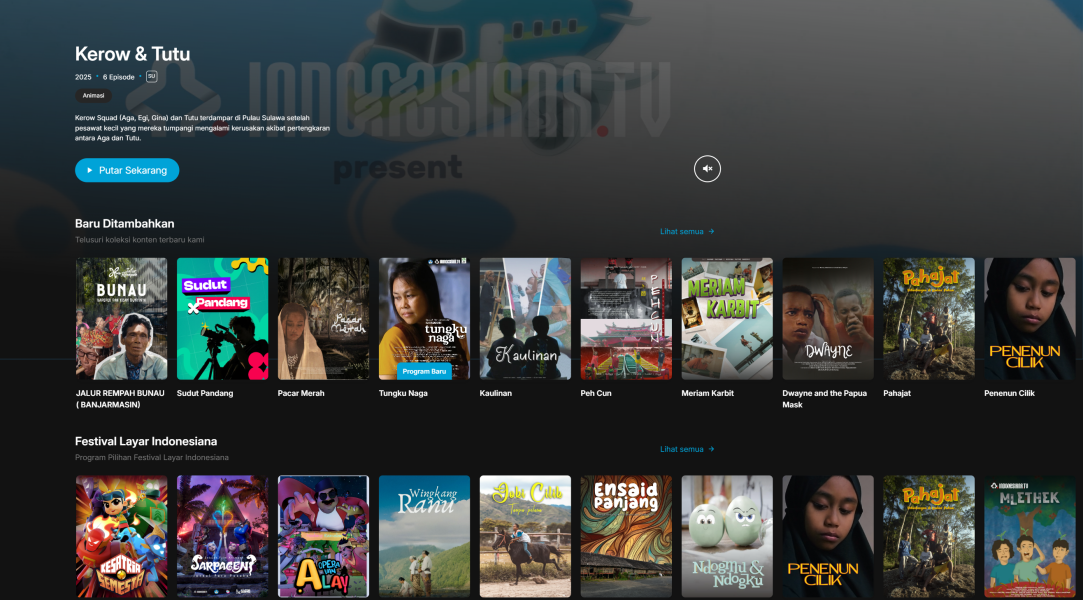
The Cultural Media Center through Indonesiana.TV plays a strategic role and function as a provider of knowledge and public information about culture, especially concerning cultural heritage, cultural sites, and cultural advancement objects. Indonesiana.TV serves as an integrated media to consolidate the publication of content in a programmed, permanent, systematic, and integrated digital media format to achieve the goal of expanding access and increasing the audience for the Ministry of Culture's content.
Digital media will continue to evolve and become an inseparable part not only for the youth but for all generations today. Digital media platforms are clearly needed so that the socialization and publication of content that has been carried out through disconnected channels from various Work Units and Technical Implementation Units of Culture can integrate and synergize into a single communication and information force that has a greater impact on society.
Indonesiana.TV broadcasts audiovisual content through its website (OTT streaming and video on demand) and applications. Even in this application form, it is the first in Indonesia to present cultural content. What is presented on Indonesiana.TV not only showcases cultural heritage content from the past but also documents the ongoing activities of preservation, development, and utilization carried out from generation to generation. The challenges ahead regarding the management direction of cultural media as a substitute for book library sources will find its way. On one hand, it is an effort to preserve the world's environment, and on the other hand, it is an adaptive response to society's needs for digital cultural library sources.
References
Jannah, Roudlotul et al. 2025. Innovation in Paper Making from Teak Leaves as an Environmentally Friendly Solution in the Paper Industry. Faedah Journal: Journal of Community Service Activities in Indonesia Volume 3 Number 1, Year 2025. Sunan Giri University Surabaya.