



Fadli Zon Receives Honorary Professor Title from Unas, Highlights the Role of Culture in Global Politics

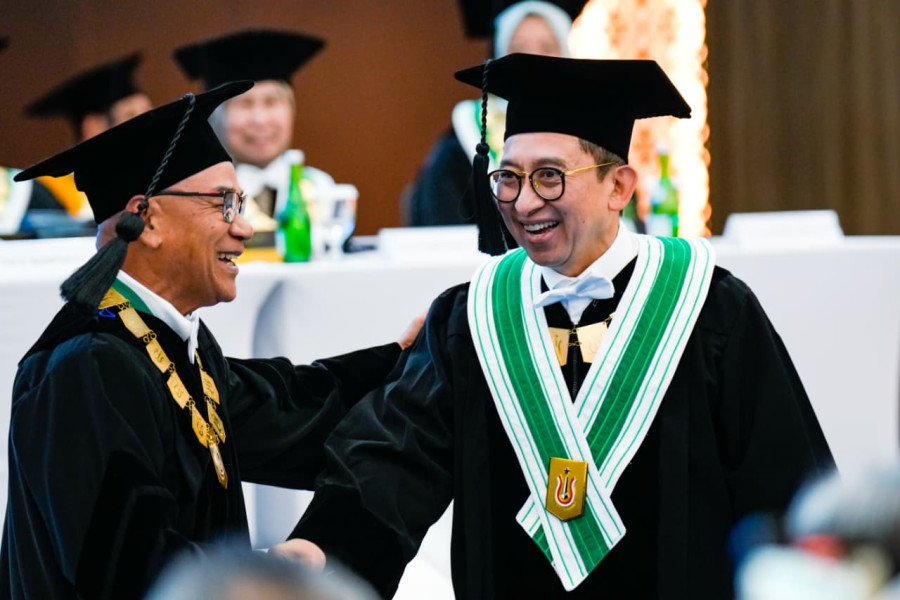
Minister of Culture Fadli Zon received the honorary title of Professor from Universitas Nasional (Unas). The award was presented during the Open Senate Meeting of Universitas Nasional at the Unas Auditorium, South Jakarta, on Wednesday (February 11, 2026). On this occasion, Fadli delivered a scientific oration titled Cultural Politics of Mega-Diversity: Indonesia as the Center of World Civilization. Several state officials were present, including MPR Chairman Ahmad Muzani, Coordinating Minister for Food Zulkifli Hasan, Coordinating Minister for Law and Human Rights Yusril Ihza Mahendra, Minister of Human Rights Natalius Pigai, and Deputy Minister of Culture Giring Ganesha.
In his oration, Fadli Zon emphasized that culture has an important position in state life. According to him, politics and culture are the conceptual foundations of a civilized nation. "The common thread of this thought emphasizes that culture is the infrastructure of meaning that supports politics, determines values, identity, and legitimacy of power. In this framework, Indonesia's mega-diversity is not just a demographic fact, but a political cultural episteme that shapes national imagination," said Fadli Zon.
He stated that the Indonesian nation has been founded on a reality of very high diversity, encompassing differences in ethnicity, language, culture, religion, and history. The vision of unity formulated by the nation's founders serves as our foundation as the next generation to consider this diversity in safeguarding the continuity of the Indonesian nation. Born from diversity presents a challenge for us to continue to strengthen our Indonesian identity.
"The principle of Bhinneka Tunggal Ika emphasizes that Indonesia's unity is not the result of uniformity of identity, but arises from a collective awareness to live together in one inclusive national community," he explained. Fadli believes that culture has a subtle yet profound influence in global politics through values, traditions, arts, language, and local knowledge. "Contemporary global practices such as the Korean Wave and the dominance of Hollywood narratives show that cultural power can shape a positive image, expand influence, and strengthen a country's economic and diplomatic position sustainably, even when the formal international order experiences erosion," he revealed.
According to him, Indonesia has the same potential if it can consciously and strategically formulate the cultural direction it wants to showcase on the world stage. He added that the role of the Ministry of Culture is crucial as a coordinator for the advancement of national culture and must involve various sectors. "Therefore, the role of the Ministry of Culture becomes important as the orchestrator of the advancement of Indonesian national culture. Its success greatly depends on the collective involvement of the entire national ecosystem, from education, tourism, creative economy, diplomacy to digital technology," he said.
A full awareness of the greatness and nobility of our culture is not merely a false pride, but can provide deep meaning in every step together to continue the ideals of our predecessors so that the existence of the Indonesian Nation is not merely a complement as citizens of the world but plays a role in civilization now and in the future.